Ninety-five thousand tonnes, seventy-three sites, and a contract the government has not kept since 1998
Home • The Back End • Where America’s Spent Fuel Sits
Abstract
Chapter 13 of The Nuclear Fuel Cycle: A Complete Primer describes spent fuel and the engineering of its storage. Chapters 16 and 22 explain why the United States has no repository. This article examines the inventory itself: how much commercial spent fuel exists, where it is stored, which licenses govern it, who pays because the federal government has not taken it, and what became of the two efforts to move it—to consolidated interim storage and a repository.
It ends by comparing the progress of six other countries working through the same process. The argument, in short: the United States has a well-characterized inventory, proven storage technology and regulation, a federal obligation dating to 1998 and money set aside for disposal, yet no durable path from storage at reactor sites to final disposal.
How Much, and Where
At the end of 2022, the United States held 90,963 tonnes of heavy metal (tHM) in spent nuclear fuel from commercial power reactors, contained in 314,878 assemblies [1]. Pressurized water reactors accounted for 58,953 tHM and boiling water reactors for 32,010 tHM [1]. DOE put the total at about 95,000 tonnes in 2025, with inventory growing by about 2,000 tHM a year [2]. The figures are consistent: two years of discharges at that rate would nearly close the gap.
At the end of 2022, commercial spent fuel was stored at 73 sites, nearly all of them the reactor sites where it was produced [3]. A Nuclear Regulatory Commission (NRC) map current as of June 2023 shows at least one licensed independent spent fuel storage installation, or ISFSI—the term for a licensed storage facility outside a reactor’s pool—in 37 states, counting licensed facilities that were never built and DOE installations [4]. A separate, much smaller inventory belongs to DOE: about 2,480 tHM at the end of 2022, held mainly at Hanford, Idaho National Laboratory, and Savannah River [3]. The rest of this article concerns commercial fuel.
Some sites no longer have operating reactors. After a plant shuts down and is decommissioned, its pool is emptied into dry casks, allowing the rest of the plant to be dismantled. What remains is a concrete pad, a fence, and a security force. A 2021 Sandia study counted 18 shutdown sites holding stranded fuel, each with its own storage installation [5]. DOE counted 20 commercial nuclear plants shut down by 2025 [2].
Pools and Casks
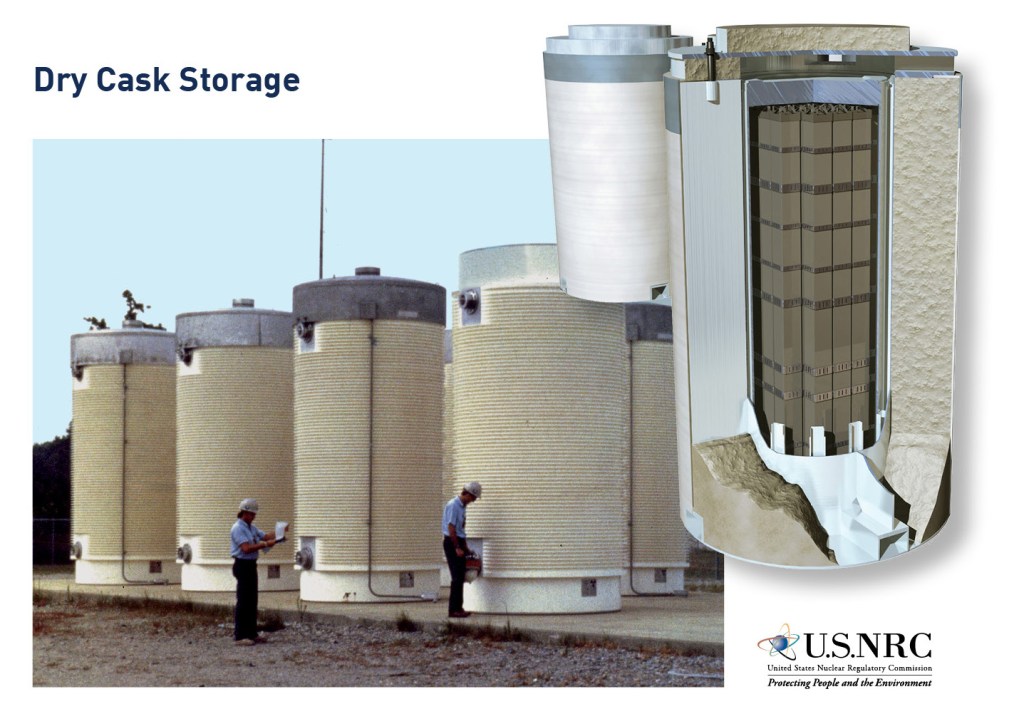
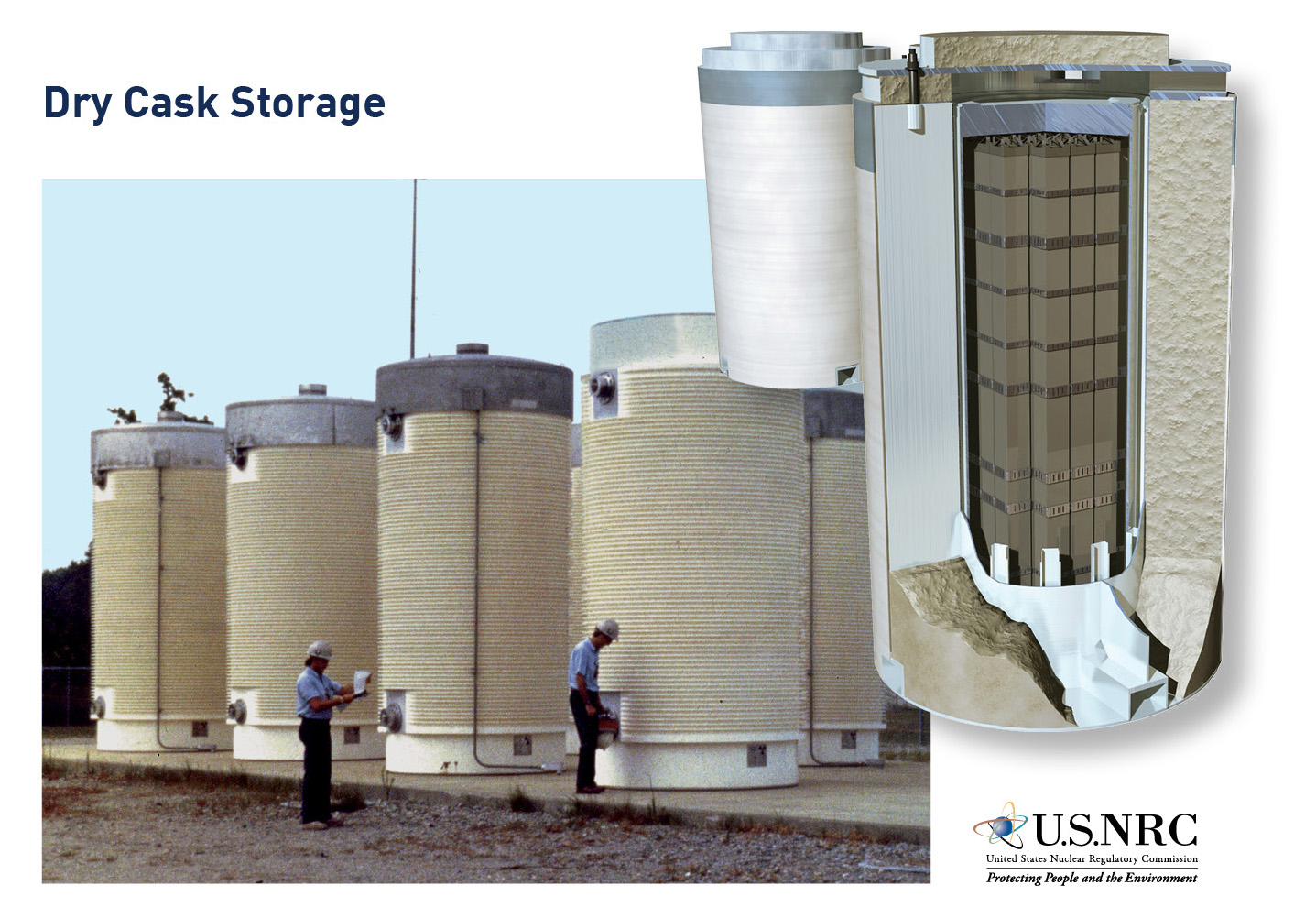
Every assembly begins its storage life in a pool beside the reactor. Water removes decay heat and shields radiation. Once the fuel has cooled enough to meet a cask’s thermal limit, it can be sealed in a steel canister inside a concrete or steel overpack. Natural air flow cools a dry cask; it needs no power.
At the end of 2022, 169,181 assemblies were in dry storage and 145,697 were in pools. Dry storage therefore held 53.7 percent of the assemblies [1]. Applying each reactor type’s average assembly mass—0.18 tHM for a boiling water reactor and 0.44 tHM for a pressurized water reactor, from the same survey—gives an estimated 49,400 tHM in dry storage and 41,600 tHM in pools. That is about 54 percent dry by mass [1]. The estimate assumes that average assembly mass is the same in a cask as in a pool. DOE’s 2025 inventory report, as summarized elsewhere, puts the dry share at about 55 percent [6].
Dry storage expands as pools fill. Pools are sized for reactor operations, not for a plant’s entire life. Once a pool is full, the usual way to make room for newly discharged fuel is to move older fuel into casks. Canisters vary by design. At Columbia Generating Station in Washington, each canister loaded in April and May 2026 held 68 boiling water reactor assemblies. Those loads brought the site’s storage pad to 60 casks [7].
TABLE 1. US commercial spent fuel by storage mode and status.
| Mode | Amount (tHM conv. = converted from assembly counts) | License basis | Status |
|---|---|---|---|
| Pools at reactor sites | 145,697 assemblies; about 41,600 tHM (conv.), end-2022 [1] | Reactor operating license | Operating |
| Dry storage at reactor sites | 169,181 assemblies; about 49,400 tHM (conv.), end-2022 [1] | 10 CFR Part 72 general license, or a site-specific license [8] | Operating |
| Interim Storage Partners, Andrews County, Texas | Up to 5,000 t licensed; none stored [9] | Part 72 specific license, September 2021, 40 years [9] | Licensed; not built; company not proceeding without Texas’s consent [10] |
| Holtec HI-STORE, Lea County, New Mexico | None stored | Part 72 specific license, May 2023 [11] | Licensed; project cancelled October 2025 [12] |
| Yucca Mountain repository | None | Designated in law; license application filed | Licensing suspended without funding [13] |
Converted tonnages assume that the average assembly mass for each reactor type applies equally to fuel in pools and dry storage. The away-from-reactor pool at Morris, Illinois, is counted with pools.
How Storage Is Licensed
Dry storage is regulated under 10 CFR Part 72, which provides two types of license [8]. The regulation grants a general license to power-reactor licensees without requiring an application. A utility may use any cask design the NRC has approved through a Certificate of Compliance, after evaluating the design against the site and registering each cask with the NRC [8] [7]. A specific license is issued to a named applicant for a particular installation after a separate safety and environmental review. The two consolidated interim storage projects hold this type of license [8] [9].
Both types of authorization have limited terms. A Certificate of Compliance may be issued for no more than 40 years [14]. A specific license may also run for up to 40 years and be renewed for additional periods of up to 40 years [15]. A February 2011 rule increased specific-license terms from 20 to 40 years. It also required renewals to rely on aging analyses and an aging management program: a plan to inspect and monitor components such as stainless-steel canisters and concrete overpacks as they age [16] [15]. A licensee that applies for renewal at least two years before expiration may continue operating under the license until the NRC decides the application [15].
The environmental question is what happens if storage lasts far longer than intended. For licensing purposes, the NRC addressed it in 2014 [17]. A federal court had struck down the NRC’s earlier Waste Confidence finding in 2012. In response, the NRC adopted the Continued Storage rule in September 2014, supported by a generic environmental impact statement [18] [17]. The statement analyzed three periods: 60 years of storage after a reactor’s licensed life ends, a further 100 years, and indefinite storage if no repository becomes available [19]. Individual licensing reviews may rely on that generic analysis. The rule did not itself authorize storage or extend any license [17].
The Contract and the Bill
The Nuclear Waste Policy Act of 1982 made disposal a federal responsibility and funded it through a fee on nuclear electricity [20]. Under the Standard Contract, which each utility signed with DOE and which is now codified at 10 CFR Part 961, DOE agreed to begin accepting spent fuel by 31 January 1998 [21]. It has not begun.
Utilities sued and won. Courts have held DOE in partial breach. The resulting damages—chiefly the cost of building and operating storage that the government was supposed to make unnecessary—are paid from the Treasury’s Judgment Fund, a permanent appropriation for judgments against the United States [22] [20]. Through fiscal 2024, the Judgment Fund had paid $11.1 billion [2]. DOE estimated its remaining liability at $37.6–44.5 billion at the end of fiscal 2024, up from $34.1–41.0 billion a year earlier [2] [23]. Adding the amount already paid to the remaining estimate gives about $49–56 billion. The sources imply this combined figure but do not state it [2] [23]. The estimate rose about $3.5 billion in that year; each year of delay adds storage costs, though changes in assumptions also move it [2] [23].
Meanwhile, the fund established to pay for disposal continued to grow. The Nuclear Waste Fund stood at $51.4 billion on 30 September 2025, up from $49.5 billion a year earlier [24] [25]. Utilities had paid in $21.8 billion, DOE’s defense waste payments $3.8 billion, and interest and other investment income $37.3 billion. The fund had spent $11.5 billion, including $7.5 billion on the first repository program [24]. Fee collection stopped in 2014, after a federal appeals court ordered DOE to propose a zero fee because it could not justify collecting the fee while no disposal program was under way [26]. With the fee at zero, the fund now grows almost entirely on investment income [24].
Two features of the arrangement help explain why it persists. Congress must appropriate money before the Nuclear Waste Fund can be spent, while damages are not paid from DOE’s budget [22]. The cost of delay therefore falls on a Treasury account that no program manages.
Interim Storage: Licensed, Then Abandoned
If a repository was not imminent, a consolidated interim storage facility could at least bring fuel from many sites to one location. Two private companies applied to the NRC for facilities in the Permian Basin. In September 2021, the NRC licensed Interim Storage Partners, a joint venture of Orano and Waste Control Specialists, to store up to 5,000 tonnes of uranium (tU) in spent fuel for 40 years in Andrews County, Texas [9]. The NRC licensed Holtec’s HI-STORE facility in Lea County, New Mexico, in May 2023 [11].
Both states passed laws opposing the facilities. Texas’s HB 7 of 2021 prohibits storing high-level radioactive waste in the state except at current or former reactor sites [27]. A 2023 New Mexico law bars storage or disposal of such waste without the state’s consent [11].
In August 2023, the Fifth Circuit vacated the Texas license. It held that federal law did not authorize the NRC to license private storage away from reactor sites. The court vacated Holtec’s license on the same ground in March 2024 [28] [29]. On 18 June 2025, the Supreme Court reversed by a six-to-three vote in NRC v. Texas [30] [9]. The Court did not decide whether the NRC had that authority. It held that, under the Hobbs Act, only a “party aggrieved” by a licensing order may seek appellate review. Under the Atomic Energy Act, a party is either the applicant or someone admitted as an intervenor [30]. Texas had submitted comments, while Fasken Land and Minerals had been denied intervention. Neither was a party, so the Fifth Circuit lacked jurisdiction [30]. Three justices dissented and would have held the license unlawful [9].
On remand, the Fifth Circuit dismissed the petitions in September 2025, restoring both licenses [31] [32]. In January 2026, the Supreme Court declined to hear a separate challenge to Holtec’s license [33].
Neither project is going ahead, although both licenses remain valid. Holtec cancelled HI-STORE in October 2025, describing the path forward in New Mexico as “untenable” [12]. Interim Storage Partners said in June 2025 that it would not continue developing its project without Texas’s consent [10]. No facility has been built, and the state laws they would have to contend with have not been tested in court.
The Federal Program in 2026
DOE’s own approach to interim storage relies on a siting process based on willing hosts. In 2023, it funded consortia of universities and community groups to advise on how consent should be sought. In early 2025, DOE renamed the effort “collaboration-based siting” [34]. In July 2025, it planned to invite expressions of interest from communities by the end of that year [2]. No invitation has been published. DOE approved a federal consolidated storage facility as a capital project in May 2024 [2]. The Nuclear Waste Fund accounts also record $7.9 million in general Treasury money spent on interim storage in fiscal 2025 [24].
Policy has since shifted toward a broader approach. A May 2025 executive order required DOE to recommend a national spent-fuel policy, including reprocessing, by January 2026 [35]. In January 2026, DOE invited states to propose Nuclear Lifecycle Innovation Campuses that would co-locate fuel fabrication, enrichment, reprocessing, and waste disposition [36]. In July 2026, Utah, Tennessee, Oklahoma, Louisiana, and Idaho signed memoranda of understanding with DOE as finalists [37].
West Virginia signed a memorandum of understanding on 2 September 2026 [37] [57]. It required any hosting agreement to cover the acceptance and management of out-of-state used and spent nuclear fuel and high-level waste. Either party could withdraw if no agreement was signed by 30 September [57]. On that date, West Virginia told DOE it would not sign [58] [59]. At September hearings in the House and Senate, DOE asked Congress for authority to negotiate host agreements and permit interim storage at campus sites [56] [62]. At the 15 September House hearing, Assistant Secretary Theodore Garrish said DOE hoped to have contractual arrangements with host states by mid-December [63]. A memorandum of understanding is not a hosting agreement. As of 30 October 2026, none of the campuses had a signed hosting agreement, site plan, license application, or funding line.
DOE has also changed its terminology. Since December 2025, its Office of Nuclear Energy has used “used nuclear fuel” instead of “spent nuclear fuel,” with the same legal meaning, and “Federal staging facilities” instead of federal consolidated interim storage facilities [55]. According to a September 2026 DOE presentation, the staging facilities are intended to be located within the campuses, licensed by the NRC under 10 CFR Part 72, and based on the same conceptual design [55]. This article uses “spent fuel,” the term used in the statute and the Standard Contract.
Yucca Mountain remains the only site designated by law for a repository [13]. In 1987, Congress narrowed the search to that site [38]. DOE filed its license application in 2008, as Chapter 22 of the primer describes. The application remains on the NRC’s docket, but the proceeding has been suspended without funding for more than a decade [13]. In late July 2026, the administration was reported to be seeking legislation to end Yucca Mountain’s status as the sole repository site and allow DOE to partner with willing states [38] [39]. On 4 August 2026, Nevada’s senators introduced the Jobs, Not Waste Act to repeal the designation and withdraw the license application [40]. The 1987 designation remains in force until Congress acts [38] [13].
Higher Burnup and the Casks
Fuel is being driven harder. Higher burnup and higher-enrichment fuel—the subject of the site’s articles on LEU+—extract more energy from each assembly. But they also leave each assembly with more decay heat and radioactivity at the same cooling time. Because casks are licensed to a heat limit, this can mean longer cooling in the pool, fewer assemblies per cask, or both. The underlying physics is settled; the size of the effect depends on the fuel and cask design. DOE plans to move a research cask of high-burnup fuel from North Anna in Virginia to Idaho National Laboratory in 2027 and open it in 2029 to examine how the fuel behaves after years in dry storage [2].
How the United States Compares
Six other countries are working through the same sequence: select a site, obtain a construction license, build the repository, obtain an operating license, and begin disposal. They have reached different stages. On 22 October 2026, Finland became the first country to receive an operating license for a spent-fuel repository.
TABLE 2. Geological disposal programs, stage reached as of 30 October 2026.
| Country | Site | Stage reached | Date | Next step |
|---|---|---|---|---|
| Finland | Onkalo, Olkiluoto (Eurajoki) | Operating license granted | Construction license November 2015; regulator’s statement 4 August 2026; operating license 22 October 2026 [41] [42] [60] | Commissioning; regulator’s inspection before first disposal [61] |
| Sweden | Forsmark (Östhammar) | Construction | Government permit 27 January 2022; construction began 15 January 2025 [43] [44] | Disposal expected in the 2030s [44] |
| France | Cigéo, Meuse/Haute-Marne | Application under review; public inquiry favorable | Application January 2023; inquiry opinion announced 14 September 2026 [45] | Authorization decree; emplacement from 2050 [46] |
| Switzerland | Nördlich Lägern | Site proposed; general license applied for | Proposal 12 September 2022; applications 19 November 2024 [47] [48] | Federal Council decision expected 2029, Parliament 2030 [47] |
| Canada | Revell site (Wabigoon Lake Ojibway Nation–Ignace) | Site selected; impact assessment begun | Selection November 2024; project description submitted by January 2026 [49] | Impact statement and initial license application [49] |
| United Kingdom | None | Siting; two communities in discussion | Lincolnshire withdrew 3 June 2025 [50] | Test of Public Support [50] |
| United States | Yucca Mountain (designated) | License application filed; review suspended | Application 2008 (primer, Chapter 22) | Action by Congress [13] |
France’s repository is designed for vitrified high-level waste and long-lived intermediate-level waste from reprocessing. It is intended to hold about 83,000 cubic meters in all, rather than spent-fuel assemblies [51].
Finland is closest to operation. On 4 August 2026, its regulator, STUK, found that Posiva’s encapsulation plant and repository met the safety requirements for an operating license [42]. On 7 September, the minister responsible said a proposal could go to the Government in October [52]. On 22 October 2026, the Finnish Government granted the license, the first operating license anywhere for a spent-fuel repository [60]. It runs through the end of 2070 and covers up to 6,500 tonnes of uranium (tU) in spent fuel from the Olkiluoto and Loviisa plants. The plan calls for about 3,300 canisters, with emplacement of up to 60 canisters a year once operations are established [61]. Disposal cannot begin until STUK has inspected the completed commissioning; no start date has been given [60] [61]. In late August 2026, Posiva drilled its first deposition hole, more than 400 meters underground [53].
Sweden is building. SKB selected Forsmark in 2009 and broke ground there in January 2025 on a repository designed to hold about 12,000 tonnes of spent fuel [54] [44]. France’s Cigéo project received a favorable public-inquiry opinion in September 2026 and now awaits a government decree [45]. Switzerland and Canada have sites but not licenses [48] [49]. The United Kingdom has not yet chosen a site; two communities remain in discussion [50].
US Spent Fuel, October 2026
- Inventory: about 95,000 tHM, growing by about 2,000 tHM a year [2]; 90,963 tHM measured at the end of 2022 [1].
- Location: 73 commercial sites [3]; a licensed storage installation in 37 states as of June 2023, including unbuilt and DOE installations [4].
- Storage: about 54 percent in dry casks by mass at the end of 2022 (estimated from assembly counts) [1].
- Licenses: casks certified for up to 40 years [14]; site-specific licenses for up to 40 years, renewable [15].
- Damages paid: $11.1 billion through fiscal 2024 [2].
- Remaining liability: $37.6–44.5 billion, fiscal 2024 [23].
- Nuclear Waste Fund: $51.4 billion on 30 September 2025 [24]; fee not collected since 2014 [26].
- Interim storage: two licenses valid [31] [33]; no facility under construction [12] [10].
- Campuses: six memoranda signed with DOE; West Virginia withdrew 30 September 2026, leaving five; no hosting agreement [37] [58] [62].
- Repository: Yucca Mountain designated in law; licensing suspended [13].
- Abroad: Finland granted the first repository operating license, 22 October 2026 [60].
What Would Change the Picture
The obstacle is no longer technical. The fuel is counted, its storage is licensed and the money has been set aside; what is missing is a site, a willing host and the authority to move the fuel. The pending decisions below each carry a date or deadline after which their effect can be checked, the American ones first and then those abroad:
- A next step from Interim Storage Partners: a statement on development, a license amendment, or a change in Texas law [10].
- A DOE solicitation or agreement: an invitation to host federal interim storage, the spent-fuel policy report the May 2025 executive order called for, or a signed hosting agreement with any of the five remaining campus finalists, which DOE said it hoped to reach by mid-December 2026 [2] [35] [37] [63].
- Congress on Yucca Mountain: action on the Jobs, Not Waste Act or on the administration’s reported proposals [40] [39].
- DOE’s next Nuclear Waste Fund audit, due in November 2026, which will update the Judgment Fund total and the remaining-liability range [24] [23].
- Onkalo’s first disposal. The Government granted the operating license on 22 October 2026; disposal begins only after STUK’s commissioning inspection, for which no date has been given [60] [61].
- Forsmark: approval by the Swedish regulator of the safety analysis report needed before repository tunnels are mined [54].
- The Cigéo authorization decree, reported in December 2025 as expected at best in 2028 [46].
Licenses and memoranda already exist, so progress at home will be marked by a signed hosting agreement, a change in the law, or spent fuel actually leaving a reactor site.
Spot an error? Suggest a correction
See also: Glossary | Companies and Participants | The Book
Notes
1. PNNL for US Department of Energy, “Summary 1. Spent Nuclear Fuel from Commercial Power Reactors Stored at Commercial Sites,” Nuclear Fuel Data Survey (Form GC-859), data through 31 December 2022. https://gc859.pnnl.gov/summary ↩
2. US Department of Energy, Office of Spent Fuel and High-Level Waste Disposition (P. Murray), “Spent Nuclear Fuel and High-Level Waste Disposition Program,” presentation to the Wyoming Legislature, July 2025; inventory, discharge rate, Judgment Fund payments, liability chart, siting roadmap and research cask plans. https://wyoleg.gov/InterimCommittee/2025/09-2025072914-02USDOEPresentation.pdf ↩
3. K. Banerjee, A. Rigato, V. Wilson, “Spent Nuclear Fuel and Reprocessing Waste Inventory,” PNNL-33938 Rev. 1.1, data to end-2022. https://curie.pnnl.gov/system/files/SNF%20and%20Rep%20Waste%20Inventory%20PNNL%2033938%20Rev.%201.1_0.pdf ↩
4. US Nuclear Regulatory Commission, “U.S. Independent Spent Fuel Storage Installations” (map), current as of June 2023, ML23165A245. https://publish.nrc.gov/docs/ML2316/ML23165A245.pdf ↩
5. Sandia National Laboratories, SAND2021-10444, August 2021; stranded fuel at shutdown reactor sites. https://www.osti.gov/servlets/purl/1817319/ ↩
6. National Center for Energy Analytics, “Unlocking U.S. Nuclear Growth Requires a Waste Strategy,” 2026; secondary, citing DOE, Spent Nuclear Fuel and Reprocessing Waste Inventory (INL/RPT-25-88353 Rev. 2, 2025). https://energyanalytics.org/nuclear-waste/ ↩
7. Energy Northwest, letter GO2-26-061, “Columbia Generating Station: Registration of Spent Fuel Cask Use,” NRC ADAMS ML26131A354, May 2026. https://www.nrc.gov/docs/ML2613/ML26131A354.pdf ↩
8. Electronic Code of Federal Regulations, 10 CFR Part 72 (sections 72.3 and 72.6; subpart K, general license), current to 14 October 2026. https://www.ecfr.gov/current/title-10/chapter-I/part-72 ↩
9. World Nuclear News, “US Supreme Court rules on interim storage facility case,” June 2025; also the license terms for Interim Storage Partners and the 6-3 vote. https://www.world-nuclear-news.org/articles/us-supreme-court-rules-on-interim-storage-facility-case ↩
10. Texas Tribune, “Supreme Court clears the way for temporary nuclear waste storage in Texas and New Mexico,” 19 June 2025; Interim Storage Partners’ statement on Texas consent. https://www.texastribune.org/2025/06/19/texas-nuclear-waste/ ↩
11. Exchange Monitor, “Holtec drops New Mexico interim spent nuclear fuel storage facility,” 10 October 2025; also the May 2023 license and New Mexico’s 2023 law. https://www.exchangemonitor.com/holtec-drops-new-mexico-interim-spent-nuclear-fuel-storage-facility/ ↩
12. American Nuclear Society, Nuclear Newswire, “Holtec pulls out of New Mexico SNF interim storage project,” 10 October 2025. https://www.ans.org/news/2025-10-10/article-7449/holtec-pulls-out-of-new-mexico-snf-interim-storage-project/ ↩
13. Congressional Research Service, R42853, “Nuclear Energy: Overview of Congressional Issues”; Yucca Mountain as the sole authorized candidate site. https://www.congress.gov/crs-product/R42853 ↩
14. Electronic Code of Federal Regulations, 10 CFR 72.238, “Issuance of an NRC Certificate of Compliance,” current to 16 October 2026. https://www.ecfr.gov/current/title-10/section-72.238 ↩
15. Electronic Code of Federal Regulations, 10 CFR 72.42, “Duration of license; renewal,” current to 16 October 2026. https://www.ecfr.gov/current/title-10/section-72.42 ↩
16. US Nuclear Regulatory Commission, “License and Certificate of Compliance Terms,” final rule, Federal Register 76 FR 8872, 16 February 2011. https://www.govinfo.gov/content/pkg/FR-2011-02-16/html/2011-3493.htm ↩
17. US Nuclear Regulatory Commission, response on long-term storage petition, 2019, ML19134A310; cites the final rule 79 FR 56238, 19 September 2014, and states its limits. https://www.nrc.gov/docs/ML1913/ML19134A310.pdf ↩
18. US Nuclear Regulatory Commission, Commission memorandum and order approving the Continued Storage Rule, August 2014, ML14238A222; also records the 2012 vacatur of the Waste Confidence decision. https://www.nrc.gov/docs/ML1423/ML14238A222.pdf ↩
19. US Nuclear Regulatory Commission, NUREG-2157, Generic Environmental Impact Statement for Continued Storage of Spent Nuclear Fuel, Vol. 1, September 2014. https://www.nrc.gov/reading-rm/doc-collections/nuregs/staff/sr2157/v1/index.html ↩
20. Congressional Research Service, RL33461, “Civilian Nuclear Waste Disposal.” https://www.congress.gov/crs-product/RL33461 ↩
21. US Department of Justice, testimony on Standard Contract litigation, “Budgeting for Nuclear Waste Management”; the 31 January 1998 acceptance date. https://www.justice.gov/file/235916-0/dl ↩
22. US Government Accountability Office, GAO-21-603, “Commercial Spent Nuclear Fuel: Congressional Action Needed to Break Impasse,” 2021. https://www.gao.gov/assets/gao-21-603.pdf ↩
23. American Nuclear Society, Nuclear Newswire, “U.S. spent fuel liability jumps to $44.5 billion,” 27 November 2024; reports the FY2024 Nuclear Waste Fund audit. https://ans.org/news/article-6587/us-spent-fuel-liability-jumps-to-445-billion ↩
24. US Department of Energy, “Nuclear Waste Fund (NWF) Annual Financial Report Summary, FY2025 and Cumulative.” https://www.energy.gov/documents/fy-2025-nwf-annual-financial-report-summary ↩
25. US Department of Energy, “Nuclear Waste Fund (NWF) Annual Financial Report Summary, FY2024 and Cumulative.” https://www.energy.gov/sites/default/files/2024-12/FY24%20-%20NWF%20Annual%20Financial%20Report%20Summary.pdf ↩
26. Congressional Budget Office (Cawley), testimony “The Nuclear Waste Fund: Budgetary, Funding, and Scoring Issues,” 3 December 2015; records the 2014 stop to fee collection under court order. https://democrats-energycommerce.house.gov/sites/evo-subsites/democrats-energycommerce.house.gov/files/Testimony-Cawley-EE-Nuclear-Waste-2015-12-3.pdf ↩
27. Texas Tribune, on Texas HB 7, 23 August 2021. https://www.texastribune.org/2021/08/23/texas-nuclear-waste-storage-site-legislature ↩
28. Texas Public Radio, “West Texas nuclear waste plan remains blocked after federal appeals court ruling,” 19 March 2024; the August 2023 vacatur. https://www.tpr.org/environment/2024-03-19/west-texas-nuclear-waste-plan-remains-blocked-after-federal-appeals-court-ruling ↩
29. Nuclear Engineering International, “Holtec scraps NM waste storage plan,” October 2025; also reports the Fifth Circuit vacatur of Holtec’s license, March 2024. https://www.neimagazine.com/news/holtec-scraps-nm-waste-storage-plan/ ↩
30. Supreme Court of the United States, Nuclear Regulatory Commission v. Texas, Nos. 23-1300 and 23-1312, slip opinion, 18 June 2025. https://www.supremecourt.gov/opinions/24pdf/23-1300_b97c.pdf ↩
31. US Court of Appeals for the Fifth Circuit, Fasken Land and Minerals v. NRC, No. 23-60377, on remand (petition dismissed). https://www.ca5.uscourts.gov/opinions/unpub/23/23-60377.1.pdf ↩
32. Spencer Fane, “Shut out of the courtroom: when procedure trumps policy in nuclear waste litigation,” 26 January 2026; reports the Fifth Circuit dismissal of 22 September 2025. https://www.spencerfane.com/insight/shut-out-of-the-courtroom-when-procedure-trumps-policy-in-nuclear-waste-litigation/ ↩
33. Exchange Monitor, “Supreme Court declines to hear Beyond Nuclear case on waste storage license,” 13 January 2026. https://www.exchangemonitor.com/supreme-court-declines-to-hear-beyond-nuclear-case-on-waste-storage-license/ ↩
34. Consortium for Risk Evaluation with Stakeholder Participation (CRESP), “Collaboration-Based Siting of a Consolidated Interim Storage Facility (CISF) Project”; 2023 consortia awards and the 2025 renaming. https://www.cresp.org/projects/collaboration-based-siting-of-a-consolidated-interim-storage-facility-cisf-project/ ↩
35. Executive Order 14302, “Reinvigorating the Nuclear Industrial Base,” Federal Register 90 FR 22595, 29 May 2025. https://www.govinfo.gov/content/pkg/FR-2025-05-29/pdf/2025-09801.pdf ↩
36. US Department of Energy, “Department of Energy Seeks Hosts for Nuclear Lifecycle Innovation Campuses,” 28 January 2026. https://www.energy.gov/node/4856008 ↩
37. US Department of Energy, Office of Nuclear Energy, “Nuclear Lifecycle Innovation Campuses” (program page), accessed 20 October 2026. https://www.energy.gov/ne/nuclear-lifecycle-innovation-campuses ↩
38. Las Vegas Sun, “Nevada officials celebrate shift of American nuclear waste strategy away from Yucca Mountain,” 30 July 2026; also the 1987 designation. https://lasvegassun.com/news/2026/jul/30/nevadans-celebrate-shift-of-american-nuclear-waste/ ↩
39. E&E News by POLITICO, “Leaked document reveals White House nuclear waste plan,” July 2026. https://www.eenews.net/articles/leaked-document-reveals-white-house-nuclear-waste-plan/ ↩
40. Office of Senator Jacky Rosen, “Rosen, Cortez Masto Introduce Bill to Overturn Law Establishing Yucca Mountain as Nuclear Waste Repository, Consider New Uses for Site,” 4 August 2026. https://www.rosen.senate.gov/2026/08/04/rosen-cortez-masto-introduce-bill-to-overturn-law-establishing-yucca-mountain-as-nuclear-waste-repository-consider-new-uses-for-site/ ↩
41. Nuclear Engineering International, “Posiva repository clears safety review,” 6 August 2026; also the 2015 construction license and the ministry’s autumn timetable. https://www.neimagazine.com/news/posiva-repository-clears-safety-review/ ↩
42. Radiation and Nuclear Safety Authority (STUK), “The Radiation and Nuclear Safety Authority supports the licence for a spent nuclear fuel final disposal facility,” 4 August 2026. https://stuk.fi/en/-/the-radiation-and-nuclear-safety-authority-supports-the-license-for-a-spent-nuclear-fuel-final-disposal-facility ↩
43. Swedish Government permit for the Forsmark repository, 27 January 2022, as reported by American Nuclear Society, Nuclear Newswire, “Sweden issues permits for spent fuel repository, encapsulation plant” (tag page). https://www.ans.org/news/tag-skb/ ↩
44. American Nuclear Society, Nuclear Newswire, “Sweden begins construction of spent fuel repository,” 17 January 2025. https://www.ans.org/news/2025-01-17/article-6693/sweden-begins-construction-of-spent-fuel-repository/ ↩
45. AFP via Connaissance des Énergies, “Déchets nucléaires : avis favorable de la commission d’enquête pour Cigéo,” 14 September 2026. https://www.connaissancedesenergies.org/afp/dechets-nucleaires-avis-favorable-de-la-commission-denquete-pour-cigeo-260914 ↩
46. AFP via Connaissance des Énergies, “Déchets radioactifs : une étape clé franchie pour le projet Cigéo,” 4 December 2025; emplacement from 2050 and the decree timetable. https://www.connaissancedesenergies.org/afp/dechets-radioactifs-une-etape-cle-franchie-pour-le-projet-cigeo-251204 ↩
47. Swiss Federal Office of Energy, “Stage 3,” Sectoral Plan for Deep Geological Repositories; site announcement of 12 September 2022 and decision timetable. https://www.bfe.admin.ch/bfe/en/home/supply/nuclear-energy/radioactive-waste/deep-geological-repositories/sectoral-plan-deep-geological-repositories/stage-3.html ↩
48. Nagra, media dossier “Securing the safest site,” general license applications of 19 November 2024. https://nagra.ch/en/media-securing-the-safest-site/ ↩
49. American Nuclear Society, Nuclear Newswire, “Canada begins regulatory approval process for spent fuel repository,” 7 January 2026. https://www.ans.org/news/2026-01-07/article-7655/canada-begins-regulatory-approval-process-for-spent-fuel-repository/ ↩
50. UK Government (Nuclear Waste Services), “Lincolnshire County Council withdraws from the GDF siting process,” 3 June 2025. https://www.gov.uk/government/news/lincolnshire-county-council-withdraws-from-the-gdf-siting-process ↩
51. Nuclear Engineering International, on ASN’s admission of the Cigéo creation authorization application, 2023; waste volume of 83,000 cubic meters. https://neimagazine.com/?p=66513 ↩
52. Finnish Government, Minister of Climate and the Environment Sari Multala, welcome address at Posiva’s facility in Eurajoki, 7 September 2026. https://valtioneuvosto.fi/documents/1410877/252371313/Multala+Onkalo+Welcome+07092026_.pdf/941e05af-1f6b-6bd8-34da-f1386c48af1c?t=1788787271434 ↩
53. Nuclear Engineering International, “Onkalo takes first step to disposal,” September 2026. https://www.neimagazine.com/news/onkalo-takes-first-step-to-disposal/ ↩
54. American Nuclear Society, Nuclear Newswire, “Sweden’s SKB approved to begin construction of spent fuel repository,” October 2024; also the 2009 site selection, capacity and the safety-report requirement. https://ans.org/news/article-6520/swedens-skb-approved-to-begin-construction-of-spent-fuel-repository ↩
55. US Department of Energy, Office of Nuclear Energy (Bickford), “Office of Nuclear Energy Update,” presentation to the Midwest Radioactive Materials Transportation Committee, 29 September 2026; the change to “used nuclear fuel” and “Federal staging facilities”. https://csgmidwest.org/wp-content/uploads/2026/09/2026.09.29-MRMTC-NE-Update-presentation-Bickford.pdf ↩
56. American Institute of Physics, FYI, “DOE Floats Nuclear Waste Consolidation Plan Amid Staffing, Oversight Concerns,” 29 September 2026; the September hearings, the authority requested and the 15 December contract target. https://www.aip.org/fyi/doe-floats-nuclear-waste-consolidation-plan-amid-staffing-oversight-concerns ↩
57. Memorandum of Understanding between the Department of Energy and the State of West Virginia concerning a Nuclear Lifecycle Innovation Campus, signed 2 September 2026 (published by The Observer). https://observerwv.com/wp-content/uploads/2026/09/US-DOE-MOU-with-West-Virginia-Sep-2026.pdf ↩
58. West Virginia Office of Energy, letter to DOE Office of Nuclear Energy declining to execute the hosting agreement, 30 September 2026. https://observerwv.com/wp-content/uploads/2026/10/wva-office-of-energy-letter-declining-participation-in-doe-nlic-project-2026-Sep-30.pdf ↩
59. The Dominion Post, “W.Va. backs out of consideration for Nuclear Lifecycle Innovation Campus,” 1 October 2026. https://www.dominionpost.com/2026/10/01/w-va-backs-out-of-consideration-for-nuclear-lifecycle-innovation-campus/ ↩
60. Posiva, “Historic decision: Finnish Government grants operating licence to Posiva,” 22 October 2026. https://www.posiva.fi/en/index/news/pressreleasesstockexchangereleases/2026/historicdecisionfinnishgovernmentgrantsoperatinglicencetoposiva.html ↩
61. Daily Finland, “Posiva granted licence to operate world’s 1st spent nuke fuel repository,” 22 October 2026; reports the Ministry of Economic Affairs and Employment release: term to 2070, 6,500 tU, canister numbers and STUK inspection. https://www.dailyfinland.fi/business/51931/Posiva-granted-licence-to-operate-worlds-1st-spent-nuke-fuel-repository ↩
62. US Department of Energy, Office of Nuclear Energy, T. Garrish, written testimony before the House Committee on Energy and Commerce, Subcommittee on Energy, “Nuclear Spent Fuel Policy: Examining Nuclear Lifecycle Innovation Campuses,” 15 September 2026; 28 responses from 26 states, six MOUs as “the first step toward … a host agreement”. https://www.energy.gov/sites/default/files/2026-09/2026.9.15_HES_Nuclear_Lifecycle_Innov_Campuses_Testimony_0.pdf ↩
63. American Nuclear Society, Nuclear Newswire, “House subcommittee discusses NLIC, nuclear spent fuel policy,” 16 September 2026; Garrish on a host agreement by the end of September and a contractual arrangement with host states by mid-December. https://www.ans.org/news/2026-09-16/article-8393/house-subcommittee-discusses-nlic-nuclear-spent-fuel-policy/ ↩


Leave a Reply