Fuel forms by reactor class: what each design loads, how highly enriched, and what has been made and irradiated
Home • The Reactor • HALEU Is Not One Product
Abstract
Many new reactor designs are described as needing high-assay low-enriched uranium, or HALEU. The term defines an enrichment range, not a fuel. Each reactor loads a specific uranium compound in a specific form. That fuel must be made on a suitable production line and qualified by irradiation under conditions relevant to the design. This article sorts designs now under NRC review, under Department of Energy authorization or in active development into four fuel classes: TRISO particles, fast-reactor fuels, fuel dissolved in salt, and ordinary uranium dioxide.
For each class, the article records published enrichment, fuel form, what has been fabricated and what has been irradiated. It also notes disagreements among sources. The record shows wide variation within the HALEU label, several advanced designs that use no HALEU, and a small stock of finished Western HALEU fuel. Here, finished fuel means HALEU fabricated into its final form for a design in one of the four classes; research-reactor U-10Mo fuel and the designs outside the four classes are counted separately. None of that fuel is interchangeable between classes.
An Enrichment Band, Not a Fuel
The Department of Energy defines HALEU as uranium enriched to between 5 and less than 20 percent uranium-235 [1]. Chapter 9 of The Nuclear Fuel Cycle: A Complete Primer observes that most Generation IV designs need it and that reactor development is advancing faster than the fuel supply. Chapter 6 explains why the West has so little HALEU enrichment capacity.
The label hides more than it shows. Enrichment is the step most of these fuels share. The steps that follow differ by design class: uranium chemistry, fuel geometry, the production plant and the irradiation record a regulator needs to accept the fuel. A tonne of HALEU suited to one design cannot be loaded into another.
The designs also span the band and extend below it. Published enrichments range from 8.5 percent for China’s operating pebble-bed reactor to 19.75 percent for two American microreactors that reached criticality in 2026 [2] [3]. Three of the five reactors that reached criticality under the Department of Energy’s pilot program that summer used ordinary fuel below 5 percent [3].
The Shared Step and the Divided Ones
Most of these fuels begin as uranium hexafluoride from a centrifuge plant. Exceptions use recovered material, such as Aurora’s uranium from EBR-II and the plutonium in MOX. Light-water fuel is converted to uranium dioxide powder, pressed into pellets and sealed in rods at existing fuel plants. TRISO fuel requires uranium kernels coated with carbon and silicon carbide, then pressed into graphite spheres or compacts on dedicated lines. Metallic fast-reactor fuel requires uranium reduced to metal and cast as an alloy. Salt-fueled reactors require uranium fluoride or chloride dissolved in a carrier salt. Table 1 shows the status of each route. This article uses fixed terms for each stage: fuel is designed, fabricated, irradiated and then qualified, and a production line is a pilot line, a line authorized by the Department of Energy, a plant licensed by the NRC, or a plant in operation.
TABLE 1. Process steps after enrichment, by fuel class
| Fuel class | Steps after enrichment | Western production, October 2026 |
|---|---|---|
| Uranium dioxide, below 5% | Conversion to UO₂ powder; pellets; rods and assemblies | Existing commercial plants, for example Framatome at Richland and Global Nuclear Fuel at Wilmington |
| TRISO | Kernels; coating with carbon and silicon carbide layers; pressing into spheres or compacts | BWXT, Lynchburg; Standard Nuclear pilot line under DOE authority (about 0.5 tU a year); TRISO-X plant licensed by the NRC, not yet operating (5 tU a year, operation projected for 2028) |
| Metallic | Reduction to uranium metal; alloying with zirconium; casting; sodium-bonded steel-clad pins | Richland metallization line, run on depleted uranium only; HALEU recovered from EBR-II fuel at Idaho; Oklo fabrication facility not yet operating |
| Fuel salt | Production of uranium fluoride or chloride; dissolution in a purified carrier salt | Idaho National Laboratory batch line for one experiment (18 kg batches); a pilot plant for IMSR salt under DOE agreement |
Sources: light-water plants [4] [5]; TRISO [6] [7] [8] [9]; metallic [10] [11] [12]; fuel salt [13] [14].
Class 1: TRISO Particles
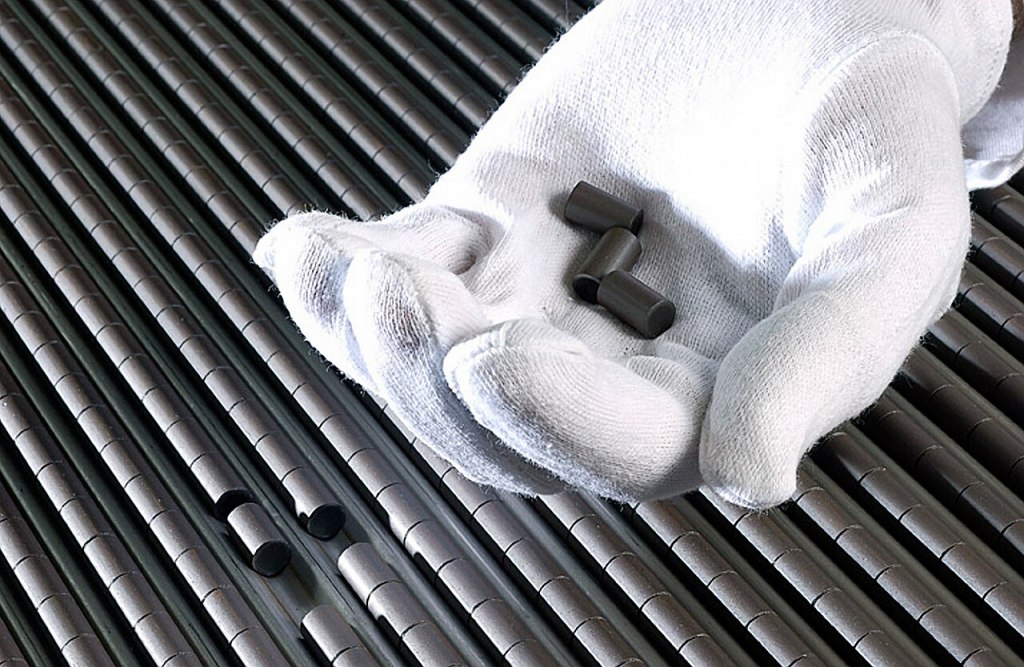
A TRISO particle is a small uranium kernel wrapped in successive carbon and silicon carbide layers that retain fission products. Chapter 7 of the primer describes its structure. In the specification used for the latest American qualification test, the kernel is 425 micrometers across [15]. Thousands of particles are pressed into a graphite sphere for a pebble bed or into a cylindrical compact. TRISO serves more designs in this article than any other class and spans the widest enrichment range.
What Has Operated
China’s HTR-PM at Shidaowan consists of two high-temperature gas-cooled reactor modules, each rated at 250 megawatts thermal, driving one 210-megawatt turbine. It entered commercial operation in December 2023 [16] [2]. Its fuel elements are 60-millimeter graphite spheres. Each sphere holds about 7 grams of heavy metal enriched to 8.5 percent and contains about 12,000 coated particles [2] [91]. China National Nuclear Corporation makes the spheres at Baotou, on a line with capacity for 300,000 spheres a year in 2015 [17]. Five HTR-PM spheres were irradiated in the Petten test reactor in the Netherlands from 2012 to 2014 without failures [17]. The enrichment is above ordinary fuel levels but well below the top of the HALEU range.
What Has Been Qualified
The Department of Energy’s Advanced Gas Reactor program has irradiated about one million TRISO particles with uranium oxycarbide (UCO) kernels. They were contained in roughly 300 compacts in Idaho National Laboratory’s Advanced Test Reactor. Peak burnup reached 19.6 percent of the heavy-metal atoms fissioned [18]. The first experiment, AGR-1, recorded no particle failures among about 300,000 particles during irradiation [19].
On 11 August 2020, the NRC approved an Electric Power Research Institute report that allows applicants to rely on the first two experiments, AGR-1 and AGR-2 [19] [20]. The approval covers compact-average burnups of 7.3 to 19.6 percent and time-averaged maximum temperatures of 1,069 to 1,360 °C [19]. It covers the particle only. Each designer must still qualify the sphere or compact that contains the particles. The approval also does not extend to conditions beyond those tested or to a reactor’s fuel system as a whole.
A later combined experiment, AGR-5/6/7, irradiated about 570,000 particles with kernels enriched to 15.5 percent at higher temperatures [15]. The experiment stopped in July 2020 at burnups of 5.7 to 15.3 percent, short of its target above 18 percent. Preliminary estimates placed in-pile failures mainly in the hottest capsule, at 180 to 440 particles [15]. Initial post-irradiation examination results were reported in October 2025; no final failure count had been published [21].
The Designs
Xe-100. X-energy’s reactor is a helium-cooled pebble bed of about 200 megawatts thermal per module, and the Long Mott station planned for Dow’s Seadrift site in Texas would have four [22] [23]. Its fuel is UCO TRISO in 60-millimeter graphite pebbles, about 18,000 particles to a pebble and more than 220,000 pebbles to a core, enriched to about 15.5 percent [9]. The construction permit application was submitted on 31 March 2025 [23]. The NRC completed its environmental assessment, with a finding of no significant impact, in May 2026, and its final safety evaluation on 30 October 2026, ahead of the November target; the Commission’s decision on the permit is still pending [23] [87].
Hermes. Kairos Power’s 35-megawatt-thermal test reactor at Oak Ridge, Tennessee uses TRISO in pebbles about 4 centimeters across, enriched up to 19.55 percent, and cools them with molten fluoride salt rather than helium [24] [25]. It has held a construction permit since December 2023, and in May 2026 the latest date for completing construction was extended to 30 April 2029 [26]. HALEU for the first load was contracted from the Department of Energy in January 2026 [27]. The pebbles are to be made at Los Alamos National Laboratory’s Low-Enriched Fuel Fabrication Facility, where Kairos expected production to begin in 2026 [28]. No pebble production there had been reported by October.
Microreactors. Two reactors in the Department of Energy’s Reactor Pilot Program reached zero-power criticality on TRISO enriched to 19.75 percent in June 2026: Antares’s Mark-0, a sodium heat-pipe design, at Idaho National Laboratory on 4 June, and Valar Atomics’ helium-cooled Ward 250 in Utah on 18 June [3] [29] [30]. BWXT supplied the Antares core from government scrap HALEU [29]; Valar has not named its supplier. Westinghouse’s eVinci uses compacts of UCO TRISO [31], BWXT’s Pele uses compacts with kernels of uranium, carbon and oxygen [6], and Radiant’s Kaleidos uses TRISO made by Standard Nuclear [32]. On 29 October 2026 the Department of Energy approved Radiant’s safety analysis for operation at power at Idaho National Laboratory, ahead of a planned 60 effective full-power days on that fuel [94]. None of the three has published an enrichment figure beyond HALEU.
The geometries differ. HTR-PM and Xe-100 use 60-millimeter spheres; Hermes uses 4-centimeter spheres. eVinci, Pele and NANO Nuclear’s KRONOS use compacts or other solid forms [33]. Because the NRC’s 2020 approval covers the particle only, each of these fuel forms must be qualified separately [19].
What Has Been Made and What Is Being Irradiated
On 2 December 2025, BWXT announced that it had completed and delivered a full core of TRISO for Pele, the Defense Department’s 1.5-megawatt transportable reactor. BWXT made the fuel at its Lynchburg, Virginia, facilities [6]. Standard Nuclear’s SN-0 line at Oak Ridge, operating under Department of Energy authority rather than an NRC license, makes about half a tonne of uranium a year as TRISO [7] [34]. It made Radiant’s first core; the first tranche had reached Idaho by 1 July 2026 [32]. In July, the company said two further lines, each rated at 1 tonne a year, were substantially complete [34].
On 27 October 2026 Antares signed an agreement with BWXT for TRISO fabricated at Lynchburg, beginning with 1 tonne of uranium (MTU) and running to the end of the decade [82] [83]. It is Antares’s second TRISO source after an August 2026 agreement with Standard Nuclear for 1 to 8 MTU through 2035 [82]. In October the Y-12 National Security Complex reported shipping HALEU oxide to Standard Nuclear for TRISO for Radiant [84].
X-energy’s TX-1 plant at Oak Ridge received NRC license SNM-7007 on 13 February 2026. The license allows production of 5 tonnes of uranium a year, enough for the first 11 Xe-100s at steady state. The plant is expected to operate from the first half of 2028 [8] [35] [9]. It will be the first purpose-built Category II fuel fabrication plant in the United States [36]. The regulations define that category as material of moderate strategic significance. It includes 10 kilograms or more of uranium-235 contained in uranium enriched to at least 10 percent but less than 20 percent [37].
X-energy’s own pebbles, made on a pilot line at Oak Ridge National Laboratory that has operated since 2016, entered the Advanced Test Reactor around November 2025 for a planned 13-month test [38] [39]. BWXT is irradiating TRISO with uranium nitride kernels. The company says these contain about 30 percent more uranium-235 per kernel than UCO [40]. Neither test had published results by October. Every design in this class uses the same particle concept, but each needs fuel made in its own kernel, enrichment and geometry.
Class 2: Fast-Reactor Fuels: Metal, Oxide and Nitride
A fast reactor has no moderator, and its fuel operates at higher power density than light-water fuel. American designs use metallic fuel: uranium alloyed with zirconium, cast into slugs and sealed in steel cladding, with liquid sodium between the fuel and cladding to carry heat. Chapter 7 of the primer explains why metal suits this service. Other countries have chosen oxide or nitride.
The Experience Base
The metallic-fuel record is American and decades old. By 1992, the EBR-II reactor in Idaho had irradiated more than 13,000 test and driver elements of uranium alloyed with 10 percent zirconium (U-10Zr), and more than 600 elements containing plutonium [41]. Endurance tests of elements clad in HT9, a ferritic-martensitic steel, were nearing 20 percent burnup without a breach [41]. EBR-II shut down in 1994 [42], and the Fast Flux Test Facility in Washington State added further tests of the same fuel [41]. Totals after 1992 for the plutonium-bearing alloys that a recycling fleet would use were not compiled in the sources reviewed.
Natrium
The NRC describes TerraPower’s Natrium fuel as a U-10Zr HALEU column with a sodium bond to HT9 cladding. The alloy, bond and cladding have the deepest EBR-II record [43]. The pool-type sodium-cooled fast reactor is rated at 840 megawatts thermal and 345 megawatts electric. Molten-salt heat storage can raise output to 500 megawatts [44] [43]. After a mandatory hearing on 4 March 2026, the NRC lists 9 March 2026 as the construction permit decision date [43]. TerraPower has said it expects to load fuel by 2030 [45].
The NRC page gives the enrichment only as HALEU [43]. In May 2025, ASP Isotopes agreed to supply HALEU from a planned enrichment plant at Pelindaba in South Africa, designed to produce about 15 tonnes of uranium a year at 19.75 percent. The initial-core agreement is intended to support Natrium’s first core, with deliveries targeted for 2027–28; a long-term agreement covers up to 150 tonnes over 2028–2037 [46].
A separate HALEU project at Pelindaba was announced on 15 October 2026. Quantum Leap Energy, an ASP Isotopes subsidiary, and Necsa signed a binding heads of agreement for a joint venture, with ownership of about 80 and 20 percent, to build and operate a test bench and a commercial-scale HALEU facility [89] [90]. The project is at an early stage. Refurbishment of the building that housed an earlier test bench is under way, but the joint venture has published no capacity, schedule or cost [89] [90]. ASP Isotopes says the joint venture’s expected output is covered by its supply agreements with TerraPower [89]; it has not said whether the joint venture’s facility is the 15-tonne plant described in 2025.
The fuel itself has not yet been made. Framatome and TerraPower completed a line at Richland, Washington, to convert uranium to metal. They announced its first output, made from depleted uranium, on 4 November 2025 [10]. A Natrium fuel facility at Global Nuclear Fuel’s Wilmington, North Carolina, site was announced on 21 October 2022 [47]. By October 2026, no report had appeared of HALEU Natrium fuel pins being made or irradiated. The NRC lists TerraPower’s fuel and control assembly qualification plan among its pre-application documents [48].
Aurora and ARC-100
Oklo’s Aurora, now described as a sodium-cooled reactor of up to 75 megawatts electric [49], is to use metallic fuel made from HALEU recovered by Idaho National Laboratory from EBR-II used driver fuel. The laboratory expects to recover just under 10 tonnes of HALEU in total; 5 tonnes are available to Oklo under a 2019 award [11] [50]. Aurora’s core enrichment has not been published. The Department of Energy approved the safety design agreement for Oklo’s Idaho fuel fabrication facility on 11 November 2025 and its preliminary documented safety analysis in December 2025 [12] [92]. In August 2026, Oklo said equipment for the facility was in production for installation and start-up activities planned for 2027 [93] [51]. The reactor’s preliminary safety analysis was approved under Department of Energy authority in June 2026 [52].
ARC Clean Technology’s ARC-100, a 100-megawatt sodium-cooled design using uranium-zirconium metal, entered a partnership with Idaho National Laboratory in July 2026; its enrichment has not been published [53].
Oxide and Nitride Abroad
Elsewhere, fast-reactor experience includes oxide and nitride fuels. Russia’s BN-800 at Beloyarsk returned to the grid on 13 September 2022 with a core made mostly of uranium-plutonium mixed oxide fuel, produced at Zheleznogorsk from reprocessed plutonium [54]. It has run on an entirely MOX core since 2023 [81]. India’s 500-megawatt Prototype Fast Breeder Reactor at Kalpakkam, also fueled with uranium-plutonium oxide, reached first criticality on 6 April 2026 [55]. China’s CFR-600 was designed to start on MOX, with metal fuel planned later [56].
For the lead-cooled BREST-OD-300, Russia began pilot operation of an on-site fabrication unit in January 2025. The unit makes prototype assemblies with depleted-uranium nitride; production of mixed uranium-plutonium nitride awaits regulatory approval [57]. In the West, newcleo plans MOX for its lead-cooled LFR-AS-200 [58]. Westinghouse’s lead-cooled design plans oxide first and uranium nitride later [59]. Each fuel needs its own production line: MOX lines handle separated plutonium, while nitride requires a separate synthesis route.
Class 3: Fuel Dissolved in Salt
In a molten salt reactor, the fuel has no solid form. Uranium is dissolved as a fluoride or chloride in a carrier salt that also carries heat. Chapter 7 of the primer describes the chemistry. Kairos’s Hermes uses molten salt only as a coolant around solid TRISO pebbles, so it belongs to the first class.
MSR-1. This is a 1-megawatt-thermal research reactor at Abilene Christian University in Texas, developed with Natura Resources. Natura reports that the NRC issued its construction permit in September 2024 [60] [61]. The reactor is now proceeding toward initial operation under Department of Energy authorization [61]. Its fuel salt is lithium and beryllium fluoride carrying uranium tetrafluoride [60]. Developer materials from 2024 give enrichment as 19.5 percent on one slide and 19.7 percent on another. They plan 300 kilograms of uranium in the initial fuel salt [60]. Lithium-beryllium fluoride salt left from Oak Ridge’s 1960s molten-salt experiment was delivered in September 2026 for the reactor’s coolant [62]. No production of the fuel salt itself had been reported.
Molten Chloride Reactor Experiment. This 150-kilowatt-thermal, fast-spectrum experiment is led by Southern Company with TerraPower and partners. It will use enriched uranium chloride in a chloride carrier salt [63] [13]. Idaho National Laboratory makes the salt from uranium metal and delivered the first 18-kilogram production batch at the end of September 2025 [13]. Criticality requires 72 to 75 batches, according to the Department of Energy as reported by World Nuclear News; the American Nuclear Society gives roughly 75 [64] [63]. The enrichment and exact salt composition have not been published. In December 2025, Idaho National Laboratory expected operations to begin “as soon as 2030” [13]. In October 2026, after the Department of Energy approved cost-shared funding for an accelerated final stage, criticality was projected “as early as 2027” [63].
IMSR. Terrestrial Energy’s Integral Molten Salt Reactor is a thermal-spectrum fluoride-salt design and the exception in this class. It is designed for standard low-enriched uranium below 5 percent, with supply contracts in place with Orano, Urenco and Westinghouse [65]. It still needs a plant to make fuel salt rather than pellets. On 22 January 2026, the company signed an agreement with the Department of Energy for a pilot plant to make that salt [14].
None of the three reactors had operated by October 2026.
Class 4: Uranium Dioxide Below 5 Percent
Light-water small modular reactor designs use ordinary uranium dioxide fuel from existing plants. NuScale’s US460 received its NRC Standard Design Approval in May 2025 [66]. It uses a half-length version of Framatome’s 17-by-17 fuel assembly, with 37 assemblies per module. They are made at Richland. In March 2026, Framatome was engaged to qualify Richland for at least 444 assemblies for NuScale’s first US customer, with delivery as early as 2030 [4].
GE Vernova Hitachi’s BWRX-300 uses the GNF2 assembly. More than 22,000 GNF2 assemblies had operated in existing reactors by 2023 [67]. In September 2026, the NRC issued the design’s first construction permit, for the Tennessee Valley Authority’s Clinch River site [68]. Holtec’s SMR-300 uses Framatome’s commercial GAIA assembly [69]. The first part of its construction permit application for Palisades was docketed in February 2026 [70]. Global Nuclear Fuel’s Wilmington plant has been licensed since February 2024 to make fuel enriched up to 8 percent [5].
Three of the five reactors that reached criticality under the Department of Energy’s pilot program in summer 2026 also used light-water reactor fuel [3] [71]:
- Aalo Atomics’ sodium-cooled test reactor uses uranium dioxide pellets in stainless-steel rods made by Global Nuclear Fuel with Urenco enrichment. A Department of Energy summary gives the enrichment as 4.95 percent; the reactor reached criticality on 4 July [72] [3]. Aalo’s 2024 design used uranium zirconium hydride. In June 2025 the company announced a change to uranium dioxide, describing 8 percent enrichment as its fuel plan [73] [74]; the Department of Energy figure is the one given for the reactor that reached criticality.
- Deployable Energy’s Unity uses annular uranium dioxide rods enriched below 5 percent. It reached criticality on 30 June [3].
- Oklo’s Groves-1 is a critical assembly rated up to 100 watts. It uses five commercial Framatome GAIA assemblies and reached criticality in Texas on 5 August [75] [76].
These are advanced reactors in coolant, size and layout, not in fuel.
Outside the Four Classes
Two designs fit none of the four classes. Idaho National Laboratory’s MARVEL microreactor uses TRIGA-type uranium zirconium hydride fuel enriched to 19.75 percent. The fuel was fabricated in France beginning in early 2024, with loading projected for 2027 [77] [78]. General Atomics’ Fast Modular Reactor would use HALEU fuel clad in silicon carbide; its prototype rods are under irradiation at Idaho [79].
Research reactors use a separate HALEU form. Acting for the National Nuclear Security Administration, Pacific Northwest National Laboratory posted a request for information (notice 0000966967) on 17 September 2026 and amended it on 9 October 2026. It concerns fabrication of uranium–10 percent molybdenum (U-10Mo) monolithic fuel for five US research reactors: ATR, HFIR, NBSR, MURR and MITR [85]. The RFI estimates annual demand at about 10,000 plates and 200 elements, requiring 3,000 to 3,500 kg of HALEU metal. It preliminarily values the market at about $100 million to $175 million a year. Letters of interest are due 21 December 2026 [85].
TABLE 2. Selected designs by fuel class, as published, October 2026
| Design | Fuel form | Published enrichment | Fuel made so far | Status |
|---|---|---|---|---|
| HTR-PM (China) | TRISO, 60 mm spheres | 8.5% | Industrial line, Baotou | Commercial operation since December 2023 |
| Xe-100 | UCO TRISO, 60 mm pebbles | About 15.5% | Pilot-line pebbles under irradiation; NRC-licensed plant not yet operating (2028 projected) | Final safety evaluation 30 October 2026; construction permit decision pending |
| Hermes | TRISO, 4 cm pebbles | Up to 19.55% | None reported | Construction permit 2023; completion date April 2029 |
| Antares Mark-0 | TRISO | 19.75% | Core supplied by BWXT | Zero-power criticality June 2026 (DOE) |
| Ward 250 | TRISO | 19.75% | Supplier not published | Zero-power criticality June 2026 (DOE) |
| Pele | TRISO compacts | HALEU, no figure published | Full core, BWXT (2025) | Testing as early as 2027 (projected) |
| Kaleidos | TRISO | HALEU, no figure published | First core, Standard Nuclear (2026) | At Idaho; DOE approved Documented Safety Analysis covering operation at power, 29 October 2026; Readiness Review and fuel loading pending; no criticality reported [94] |
| Natrium | U-10Zr metal, sodium-bonded, HT9 cladding | HALEU; supplier plant designed for 19.75% | Depleted-uranium metal only | Construction permit issued March 2026 |
| Aurora | Metal from EBR-II material | HALEU, no figure published | Fabrication facility not yet operating | DOE preliminary safety analysis approved June 2026 |
| MSR-1 | Uranium tetrafluoride in lithium-beryllium fluoride | 19.5% or 19.7% (sources conflict) | None reported | NRC construction permit 2024 (developer report); DOE authorization |
| Molten Chloride Reactor Experiment | Uranium chloride salt | Not published | First 18 kg batch of 72–75 | DOE authorization |
| IMSR | Fluoride fuel salt | Below 5% | None; pilot plant under agreement | NRC pre-application |
| BWRX-300 | UO₂, GNF2 assembly | Below 5% (secondary source) | Commercial assembly | Construction permit, Clinch River, September 2026 |
| Aalo test reactor | UO₂ pellets, steel-clad rods | 4.95% (DOE) | Commercial supplier (Global Nuclear Fuel) | Zero-power criticality July 2026 (DOE) |
Sources: HTR-PM [2] [17] [91]; Xe-100 [9] [23] [87]; Hermes [24] [26]; Antares and Ward 250 [3] [29]; Pele [6]; Kaleidos [32]; Natrium [43] [46] [10]; Aurora [12] [52] [92] [93]; MSR-1 [60] [61]; Molten Chloride Reactor Experiment [13] [63]; IMSR [65] [14]; BWRX-300 [67] [68] [80]; Aalo [3] [72] [74]. The BWRX-300 enrichment comes from a secondary review; the vendor’s qualification document does not state it.
Fuel by Class, October 2026
- TRISO: enrichments range from 8.5 percent (operating HTR-PM) to 19.75 percent (Antares and Valar) [2] [3]. Western cores have been made for Pele (BWXT), Antares Mark-0 (BWXT) and Kaleidos (Standard Nuclear) [6] [29] [32]. BWXT’s Lynchburg facilities and one DOE-authorized pilot line have fabricated cores; an NRC-licensed plant is projected to operate from 2028 [6] [7] [9]. Antares added BWXT as a second TRISO supplier in October 2026 [82]. The NRC has accepted the UCO particle, not any sphere or compact, for AGR-1 and AGR-2 conditions [19].
- Fast-reactor fuels: a deep EBR-II record for U-10Zr [41]. Natrium’s HALEU fuel not yet made; metallization demonstrated on depleted uranium [10]. MOX in operation at BN-800 and in commissioning at Kalpakkam [54] [55].
- Fuel salt: the first enriched chloride batch made, 18 kg of the 72 to 75 batches needed (DOE, via WNN) [13] [64]. No fluoride fuel salt production reported.
- Uranium dioxide below 5 percent: the existing supply chain, used by the light-water SMRs and by three of the five 2026 pilot criticalities [3].
What Would Change the Picture
Funding for new fuels continues. On 29 October 2026, ARPA-E selected eight projects under its HORNIG program to fabricate, test and qualify fuels made with recycled transuranic elements. The announcement sets a combined ceiling of up to $50 million [86]. The eight published amounts total almost $45 million, with the largest at $7 million each [88]. Selection begins negotiation; it is not an award [86].
Across the four classes, the reactors are further along than their fuel. The light-water SMRs draw on a fuel supply that already exists; every HALEU class depends on fabrication lines and irradiation data that are only now arriving, and in some cases on fuel that has not yet been made. The milestones worth watching are therefore fuel milestones, and five of them would change the picture. First, HALEU metal from the Richland line would be the first step toward Natrium’s fuel. Second, pebbles from Los Alamos would mark progress for Hermes. Third, results from X-energy’s pebble irradiation in the Advanced Test Reactor would provide the first in-reactor data for a commercial Western pebble. Fourth, operation of the TRISO-X plant would mark the start of the first NRC-licensed commercial line for HALEU fuel. Fifth, fuel salt for MSR-1 would be the first fluoride fuel salt made for any of the designs in this article.
Until then, the finished HALEU fuel on record for the four classes in the United States, as defined above, consists of a few TRISO microreactor cores and the first batches of chloride salt [6] [29] [32] [3] [13]. It is backed by BWXT’s Lynchburg facilities, one TRISO pilot line operating under Department of Energy authority, and a government stock of uranium recovered from EBR-II, which shut down in 1994 [6] [7] [11] [42]. Each part of that stock serves one reactor class.
Spot an error? Suggest a correction
See also: Glossary | Companies and Participants | The Book
Notes
1. US Department of Energy, Office of Nuclear Energy, “What is High-Assay Low-Enriched Uranium (HALEU)?”, 3 December 2024 (first published April 2020). https://www.energy.gov/ne/articles/what-high-assay-low-enriched-uranium-haleu ↩
2. World Nuclear News, “China’s demonstration HTR-PM enters commercial operation,” 6 December 2023. https://world-nuclear-news.org/articles/chinese-htr-pm-demo-begins-commercial-operation ↩
3. T. J. Garrish, US Department of Energy, Office of Nuclear Energy, “Reactor Pilot Program Update,” slides, July 2026 (ML26198A212); gives fuel form, enrichment and criticality dates for the pilot reactors. https://www.nrc.gov/docs/ML2619/ML26198A212.pdf ↩
4. NuScale Power, “Framatome and NuScale Power Contract to Support Global Supply Chain and Accelerate Fuel Delivery,” 10 March 2026. https://www.nuscalepower.com/press-releases/2026/framatome-and-nuscale-power-contract-to-support-global-supply-chain-and-accelerate-fuel-delivery ↩
5. GE Vernova, “GE Vernova nuclear fuel business receives regulatory approval to manufacture higher enrichment fuel,” 14 February 2024. https://www.gevernova.com/news/press-releases/ge-vernova-nuclear-fuel-business-receives-regulatory-approval-to-manufacture-higher-enrichment-fuel ↩
6. BWXT, “BWXT Delivers Full Core of TRISO Nuclear Fuel for Project Pele Microreactor,” 2 December 2025. https://investors.bwxt.com/news-releases/news-release-details/bwxt-delivers-full-core-triso-nuclear-fuel-project-pele ↩
7. Nuclear Engineering International, “Standard starts TRISO production,” 29 January 2026. https://www.neimagazine.com/news/standard-nuclear-starts-triso-production/ ↩
8. X-energy, “TRISO-X Receives First-Ever Part 70 HALEU Fuel Fabrication License,” 13 February 2026. https://x-energy.com/news/triso-x-receives-first-ever-part-70-haleu-fuel-fabrication-license/ ↩
9. J. K. Wheeler, X-energy, “Advanced Reactor Landscape – Fuel Development,” slides to the NRC, 21 July 2026 (ML26196A356); Xe-100 fuel enrichment, pebble and core figures, and TX-1 capacity and schedule. https://www.nrc.gov/docs/ML2619/ML26196A356.pdf ↩
10. TerraPower, “Framatome and TerraPower achieve breakthrough in uranium metallization for advanced reactor fuel commercialization,” 4 November 2025. https://www.terrapower.com/framatome-and-terrapower-achieve-breakthrough-in-uranium-metallization-for-advanced-reactor-fuel-commercialization ↩
11. American Nuclear Society, Nuclear Newswire, “Leading the charge: INL’s role in advancing HALEU production,” 23 October 2025; gives the expected total of HALEU from EBR-II fuel. https://www.ans.org/news/2025-10-23/article-7387/leading-the-charge-inls-role-in-advancing-haleu-production/ ↩
12. Oklo, announcement of DOE approval of the Nuclear Safety Design Agreement for the Aurora Fuel Fabrication Facility, 11 November 2025. https://oklo.com/newsroom/news-details/2026/Oklo-Announces-U-S–Department-of-Energy-Approval-for-Nuclear-Safety-Design-Agreement-of-Aurora-Powerhouse-at-Idaho-National-Laboratory/default.aspx ↩
13. Idaho National Laboratory, “Idaho lab produces first-ever fuel for fast molten salt reactor experiment,” 3 December 2025. https://inl.gov/feature-story/idaho-lab-produces-first-ever-fuel-for-fast-molten-salt-reactor-experiment-opening-door-to-maritime-commercial-reactor-deployment/ ↩
14. Terrestrial Energy, “Terrestrial Energy Executes DOE Agreement for Project TEFLA Under Fuel Line Pilot Program,” 22 January 2026. https://www.nasdaq.com/press-release/terrestrial-energy-executes-doe-agreement-project-tefla-under-fuel-line-pilot-program ↩
15. P. Demkowicz, Idaho National Laboratory, “AGR-5/6/7 Irradiation Results and Reporting,” gas-cooled reactor program review, 13 July 2021. https://art.inl.gov/Meetings/GCR_Program_Review_07-13-21/Presentations/Session%201/7%20Demkowicz%20-AGR567%20Irradiation%20Results%20and%20Reporting.pdf ↩
16. World Nuclear News, “China’s demonstration HTR-PM reaches full power,” December 2022; gives the two-module, 210 MWe configuration. https://world-nuclear-news.org/articles/china-s-demonstration-htr-pm-reaches-full-power ↩
17. World Nuclear News, “Irradiation trials of HTR-PM fuel completed,” 5 January 2015; also gives the Baotou line capacity. https://world-nuclear-news.org/articles/irradiation-trials-of-htr-pm-fuel-completed ↩
18. P. Demkowicz, Idaho National Laboratory, “AGR Overview,” DOE-NE Advanced Reactor Technologies gas-cooled reactor program review, 2023. https://art.inl.gov/2023%20Meetings/2023%20DOE-NE%20ART%20GCR%20Program%20Review/Day%201%20Presentations/AGR%20Overview_Paul%20Demkowicz_Final.pdf ↩
19. Electric Power Research Institute and US Nuclear Regulatory Commission, Uranium Oxycarbide (UCO) TRISO Coated Particle Fuel Performance, EPRI-AR-1(NP)-A, including the NRC final safety evaluation of 11 August 2020, November 2020 (ML20336A054). https://ww2.nrc.gov/docs/ML2033/ML20336A054.pdf ↩
20. Electric Power Research Institute, transmittal of EPRI-AR-1(NP)-A to the NRC, 23 November 2020 (ML20336A053). https://ww2.nrc.gov/docs/ML2033/ML20336A053.pdf ↩
21. Oak Ridge National Laboratory, publication record, “Initial Results from Post Irradiation Examination of AGR-5/6/7 TRISO Fuel,” TopFuel 2025. https://www.ornl.gov/publications/initial-results-from-post-irradiation-examination-of-agr-5-6-7-triso-fuel/ ↩
22. World Nuclear News, “Licensing milestone for Texas SMR plant,” 19 May 2026; supports the Xe-100 module rating and four-module Long Mott plan. https://www.world-nuclear-news.org/articles/licensing-milestone-for-texas-smr-plant ↩
23. US Nuclear Regulatory Commission, “Long Mott Energy, LLC” construction permit application page, updated 14 September 2026. https://www.nrc.gov/reactors/new-reactors/advanced/who-were-working-with/applicant-projects/long-mott ↩
24. US Nuclear Regulatory Commission, NUREG-2263, Environmental Impact Statement for the Construction Permit for the Kairos Hermes Test Reactor, August 2023 (ML23214A269); gives pebble diameter and enrichment. https://www.nrc.gov/docs/ML2321/ML23214A269.pdf ↩
25. US Nuclear Regulatory Commission, “Hermes – Kairos” non-power facility licensing page, updated 15 September 2026. https://www.nrc.gov/reactors/non-power/new-facility-licensing/hermes-kairos ↩
26. Federal Register, “In the Matter of Kairos Power LLC; Hermes Test Reactor; Extension of Latest Date for Completion of Construction,” 18 May 2026. https://www.federalregister.gov/documents/2026/05/18/2026-09880/in-the-matter-of-kairos-power-llc-hermes-test-reactor-extension-of-latest-date-for-completion-of ↩
27. World Nuclear News, “Kairos secures HALEU for Hermes’ first fuel load,” 23 January 2026. https://www.world-nuclear-news.org/articles/kairos-secures-haleu-for-hermes-first-fuel-load ↩
28. Kairos Power, “Vertical Integration” (undated; retrieved 20 October 2026); describes pebble production planned at the Los Alamos Low-Enriched Fuel Fabrication Facility. https://www.kairospower.com/vertical-integration ↩
29. World Nuclear News, “First criticality for US microreactor under DOE programme,” 5 June 2026; Antares Mark-0 and its BWXT-supplied fuel. https://www.world-nuclear-news.org/articles/first-criticality-for-us-microreactor-under-doe-program ↩
30. American Nuclear Society, Nuclear Newswire, “Valar’s Ward 250 reaches criticality in Utah,” 22 June 2026. https://www.ans.org/news/2026-06-22/article-8136/valars-ward-250-reaches-criticality-in-utah/ ↩
31. Westinghouse, “TRISO Fuel Design Methodology Topical Report,” EVR-LIC-RL-003-NP Rev. 0, 2024 (ML24214A281); eVinci fuel compacts with UCO TRISO. https://www.nrc.gov/docs/ML2421/ML24214A281.pdf ↩
32. Radiant Nuclear, “Radiant receives first TRISO fuel shipment at INL’s DOME facility,” 1 July 2026. https://www.radiantnuclear.com/blog/triso-fuel-inl/ ↩
33. US Nuclear Regulatory Commission, safety evaluation of the University of Illinois MMR Fuel Qualification Methodology topical report, 1 April 2025 (ML25101A110); describes the fully ceramic micro-encapsulated fuel with UCO TRISO used by the KRONOS design. https://www.nrc.gov/docs/ML2510/ML25101A110.pdf ↩
34. American Nuclear Society, Nuclear Newswire, “Standard Nuclear plans TRISO production at two new facilities in 2026,” 24 July 2026. https://www.ans.org/news/article-8241/standard-nuclear-plans-triso-production-at-two-new-facilities-in-2026/ ↩
35. Federal Register, notice of issuance of license SNM-7007 to TRISO-X LLC, 16 March 2026, document 2026-05086. https://www.federalregister.gov/documents/full_text/xml/2026/03/16/2026-05086.xml ↩
36. American Nuclear Society, Nuclear Newswire, “NRC grants license for TRISO-X fuel manufacturing using HALEU,” 17 February 2026. https://www.ans.org/news/2026-02-17/article-7762/nrc-grants-license-for-trisox-fuel-manufacturing-using-haleu/ ↩
37. US Code of Federal Regulations, 10 CFR 74.4, definition of “special nuclear material of moderate strategic significance”; supports the Category II threshold for uranium enriched to 10–20 percent. https://www.ecfr.gov/current/title-10/chapter-I/part-74 ↩
38. World Nuclear News, “US lab begins TRISO fuel irradiation test,” 7 November 2025; also reports the TRISO-X pilot line at Oak Ridge National Laboratory operating since 2016. https://world-nuclear-news.org/articles/us-lab-begins-triso-fuel-irradiation-test ↩
39. American Nuclear Society, Nuclear Newswire, “X-energy begins irradiation testing at INL,” 12 November 2025. https://www.ans.org/news/2025-11-12/article-7535/xenergy-begins-irradiation-testing-at-inl/ ↩
40. BWXT, “BWXT Advanced Nuclear Reactor: ARDP, Fuel Qualification, 2026 Q3 Update,” slides to the NRC, 22 September 2026 (ML26252A153). https://www.nrc.gov/docs/ML2625/ML26252A153.pdf ↩
41. Pahl, Porter, Crawford and Walters, “Irradiation Behavior of Metallic Fast Reactor Fuels,” Journal of Nuclear Materials 188 (1992) 3–9. https://www.pnnl.gov/sites/default/files/media/file/Irradiation%20Behavior%20of%20Metallic%20Fast%20Reactor%20Fuels.pdf ↩
42. Argonne National Laboratory, “FIPD: EBR-II Fuels Irradiation & Physics Database — About,” retrieved 20 October 2026; gives the 1994 shutdown. https://fipd.ne.anl.gov/about/ ↩
43. US Nuclear Regulatory Commission, TerraPower (Kemmerer Unit 1) license activities page, retrieved 20 October 2026; gives the fuel description, 840 MWt rating and construction permit decision date. https://www.nrc.gov/reactors/new-reactors/advanced/who-were-working-with/past-license-activities/terrapower ↩
44. Federal Register, Kemmerer Power Station Unit 1, Final Environmental Impact Statement (NUREG-2268), 23 October 2025; gives the Natrium thermal and electric ratings. https://www.govinfo.gov/content/pkg/FR-2025-10-23/html/2025-19648.htm ↩
45. American Nuclear Society, Nuclear Newswire, “NRC completes safety review for TerraPower’s Kemmerer project,” 3 December 2025; reports TerraPower’s fuel-loading target. https://www.ans.org/news/2025-12-03/article-7590/nrc-completes-safety-review-for-terrapowers-kemmerer-project ↩
46. ASP Isotopes Inc., Form 8-K, Item 1.01, reporting the loan and supply agreements with TerraPower (period of report 16 May 2025), filed 22 May 2025. This is not the Exhibit 99.1 press release filed 20 May 2025. https://www.sec.gov/Archives/edgar/data/1921865/000147793225004124/aspi_8k.htm ↩
47. TerraPower, “Global Nuclear Fuel and TerraPower Announce Natrium Fuel Facility,” 21 October 2022. https://www.terrapower.com/global-nuclear-fuel-and-terrapower-announce-natrium-fuel-facility ↩
48. US Nuclear Regulatory Commission, Natrium pre-application activities page, retrieved 20 October 2026; lists the fuel and control assembly qualification plan. https://www.nrc.gov/reactors/new-reactors/advanced/who-were-working-with/pre-application-activities/natrium.html ↩
49. US Nuclear Regulatory Commission, Oklo Aurora Powerhouse pre-application page, updated 15 September 2026. https://www.nrc.gov/reactors/new-reactors/advanced/who-were-working-with/pre-application-activities/okla-aurora-powerhouse ↩
50. US Department of Energy, “U.S. Department of Energy Signs Off on Oklo Fuel Fabrication Facility Design Concept,” 15 October 2024; also reports Oklo’s access to 5 t of HALEU recovered from EBR-II. https://www.energy.gov/node/4845950 ↩
51. Pulse 2.0, “Oklo: Centrus Deal Could Supply HALEU For Five Aurora Powerhouses As Fuel Fabrication Startup Activities Target 2027,” 17 August 2026. https://pulse2.com/oklo-centrus-deal-could-supply-haleu-for-five-aurora-powerhouses-as-fuel-fabrication-startup-activities-target-2027/ ↩
52. American Nuclear Society, Nuclear Newswire, “Oklo secures DOE PDSA approval,” 12 June 2026. https://www.ans.org/news/2026-06-12/article-8119/oklo-secures-doe-pdsa-approval/ ↩
53. American Nuclear Society, Nuclear Newswire, “ARC partners with INL for first reactor deployment,” 31 July 2026. https://www.ans.org/news/2026-07-31/article-8260/arc-partners-with-inl-for-first-reactor-deployment/ ↩
54. World Nuclear News, “Beloyarsk BN-800 fast reactor running on MOX,” 13 September 2022. https://wnn.world-nuclear.org/articles/beloyarsk-bn-800-fast-reactor-running-on-mox ↩
55. Department of Atomic Energy, India, “Prototype Fast Breeder Reactor at Kalpakkam, Tamil Nadu attains first criticality,” 7 April 2026. https://dae.gov.in/prototype-fast-breeder-reactor-at-kalpakkam-tamil-nadu-attains-first-criticality ↩
56. World Nuclear News, “Chinese fast reactor completes trial operating cycle,” 11 August 2020; describes the CFR-600 fuel plan. https://www.world-nuclear-news.org/articles/chinese-fast-reactor-completes-trial-operating-cyc ↩
57. World Nuclear News, “BREST-OD-300 fuel fabrication facility begins pilot operation,” 3 January 2025. https://www.world-nuclear-news.org/articles/brest-od-300-fuel-fabrication-facility-begins-pilot-operation ↩
58. World Nuclear News, “Newcleo sets out plan for licensing of US MOX plant,” 7 August 2026. https://wnn.world-nuclear.org/articles/newcleo-sets-out-plan-for-licensing-of-us-mox-plant ↩
59. Westinghouse, “The Westinghouse Lead Fast Reactor,” presentation to the IAEA FR22 conference, April 2022. https://conferences.iaea.org/event/218/contributions/18730/attachments/11938/17808/286_Westinghouse_LFR_IAEA_FR22_April_2022.pdf ↩
60. Biegalski and Towell, “MC&A plan for Abilene Christian University’s Natura MSR-1 Reactor,” ORNL Molten Salt Reactor Workshop, 6 November 2024; gives the fuel salt, enrichment and uranium inventory. https://msrworkshop.ornl.gov/wp-content/uploads/2024/12/MCA-Plan-for-ACU-Natura-MSR-1-Reactor_Biegalksi.pdf ↩
61. Natura Resources, “Natura Advances MSR-1 Toward Criticality Through DOE Pilot Program,” 15 December 2025; states the September 2024 NRC construction permit. https://naturaresources.com/news/natura-advances-msr-1-toward-criticality-through-doe-pilot-program ↩
62. Natura Resources, “Natura Receives Historic Molten Salt Reactor Coolant from Department of Energy,” 18 September 2026. https://www.prnewswire.com/news-releases/natura-receives-historic-molten-salt-reactor-coolant-from-department-of-energy-302882703.html ↩
63. American Nuclear Society, Nuclear Newswire, “Molten salt–fueled reactor experiment approved for DOE cost-shared funding,” 15 October 2026. https://www.ans.org/news/article-8491/molten-saltfueled-reactor-experiment-approved-for-doe-costshared-funding/ ↩
64. World Nuclear News, “First fuel produced for molten salt reactor experiment,” 4 December 2025. https://world-nuclear-news.org/articles/first-fuel-produced-for-molten-salt-reactor-experiment ↩
65. Nuclear Engineering International, “Terrestrial proposes new IMSR construction pathway,” 14 October 2026; gives the IMSR fuel enrichment and supply contracts. https://www.neimagazine.com/?p=108132 ↩
66. US Nuclear Regulatory Commission, NuScale US460 applicant project page, retrieved 20 October 2026. https://www.nrc.gov/reactors/new-reactors/advanced/who-were-working-with/applicant-projects/nuscale-us460.html ↩
67. GE Hitachi, BWRX-300 GNF2 Fuel Design Qualification and BWR Fuel Licensing, NEDO-33977 Rev. 1, May 2023, Canadian Nuclear Safety Commission hearing record CMD24-H3. https://api.cnsc-ccsn.gc.ca/dms/digital-medias/CMD24-H3-Ref-BWRX-300-DNNP-GNF2-Fuel-Design-Qualification-and-BWR-Fuel-Licensing-Non-Proprietary-Information.PDF/object ↩
68. World Nuclear News, “First construction permit issued for BWRX-300 SMR in the US,” 30 September 2026. https://world-nuclear-news.org/articles/first-construction-permit-issued-for-bwrx300-smr-in-us ↩
69. World Nuclear News, “Holtec SMR to use commercially-available Framatome fuel,” 29 April 2020. https://world-nuclear-news.org/articles/holtec-smr-to-use-commercially-available-framatome ↩
70. US Nuclear Regulatory Commission, SMR-300 pre-application page, retrieved 20 October 2026. https://www.nrc.gov/facilities-safety/new-reactors/advanced-reactors/who-were-working-with/pre-application-activities/smr-llc-a-holtec-international-company/smr-300 ↩
71. US Department of Energy, Office of Nuclear Energy, “Office of Nuclear Energy Celebrates Fifth Advanced Reactor Criticality,” 6 August 2026. https://www.energy.gov/ne/articles/office-nuclear-energy-celebrates-fifth-advanced-reactor-criticality ↩
72. World Nuclear News, “Aalo secures fuel and turbine for experimental reactor,” 4 March 2026. https://www.world-nuclear-news.org/articles/aalo-secures-fuel-and-turbine-for-experimental-reactor ↩
73. Aalo Atomics, “Aalo-1 fuel: Why we chose uranium zirconium hydride,” 5 June 2024. https://www.aalo.com/post/why-we-chose-uranium-zirconium-hydride ↩
74. Aalo Atomics, “Unlocking Hypergrowth: Our Bold Move in Nuclear Fuel,” 16 June 2025; announces the change from hydride to uranium dioxide fuel. https://www.aalo.com/post/unlocking-hypergrowth-our-bold-move-in-nuclear-fuel ↩
75. US Department of Energy, NEPA categorical exclusion determination CX-271014, Groves-1 Project (Oklo), DOE-ID-26-006, June 2026. https://www.energy.gov/sites/default/files/2026-06/CX-271014.pdf ↩
76. POWER, “Oklo’s Groves Becomes Fifth DOE Pilot Reactor to Reach Criticality, First on Private Land,” August 2026. https://www.powermag.com/oklos-groves-becomes-fifth-doe-pilot-reactor-to-reach-criticality-first-on-private-land/ ↩
77. Jackson, Patterson and Abou Jaoude, “MARVEL Reactor: Status, Construction, and Testing,” INL/CON-24-80636, Idaho National Laboratory, October 2024. https://inldigitallibrary.inl.gov/content/uploads/50/2026/04/Sort_132605.pdf ↩
78. US Department of Energy, Office of Nuclear Energy, “Fuel Fabrication Starts for MARVEL Microreactor,” 7 February 2024. https://www.energy.gov/ne/articles/fuel-fabrication-starts-marvel-microreactor ↩
79. US Department of Energy, Office of Nuclear Energy, “General Atomics Finalizes Concept for New Fast Reactor Design,” 25 November 2025. https://www.energy.gov/node/4855366 ↩
80. Sun and Kurosaki, “Technical Overview of Recent Developments in Small Modular Reactors in the United States,” arXiv:2504.02599, 4 April 2025 (a secondary review; used only for light-water SMR enrichments). https://arxiv.org/pdf/2504.02599 ↩
81. World Nuclear Association, “Russia’s Nuclear Fuel Cycle,” Information Library, updated 30 September 2026. https://world-nuclear.org/information-library/country-profiles/countries-o-s/russia-nuclear-fuel-cycle ↩
82. POWER, “Antares Secures BWXT Fuel Agreement, Advances DOE Review for Electricity-Producing Mark-1,” 27 October 2026. https://www.powermag.com/antares-secures-bwxt-fuel-agreement-advances-doe-review-for-electricity-producing-mark-1/ ↩
83. Antares, “Antares Signs TRISO Fuel Agreement with BWXT, Securing Fabrication Through the End of the Decade,” Business Wire, 27 October 2026. https://www.businesswire.com/news/home/20261027445858/en/Antares-Signs-TRISO-Fuel-Agreement-with-BWXT-Securing-Fabrication-Through-the-End-of-the-Decade ↩
84. Y-12 National Security Complex, “Y-12 fuels research and medicine,” press release, 19 October 2026; HALEU oxide shipment to Standard Nuclear. http://www.y12.doe.gov/new/press-releases/y-12-fuels-research-and-medicine ↩
85. Pacific Northwest National Laboratory (Battelle) for NNSA Office of Reactor Conversion and Uranium Supply, “RFI U-10Mo Fuel Fabrication,” SAM.gov notice 0000966967, published 17 September 2026, amended 9 October 2026; RFI 966967, “U-10Mo Monolithic Fuel Fabrication,” Revision 0, 17 September 2026, Sections 4–5. https://sam.gov/workspace/contract/opp/b9bede571bc0454095ca5ec55bb1597f/view ↩
86. ARPA-E, “DOE’s ARPA-E Announces Up to $50 Million in Project Selections to Advance Next-Generation Nuclear Fuels,” 29 October 2026. https://arpa-e.energy.gov/news-and-events/news-and-insights/does-arpa-e-announces-50-million-project-selections-advance-next-generation-nuclear-fuels ↩
87. X-energy, “NRC Completes Landmark Safety Review of X-energy’s Xe-100 SMR,” GlobeNewswire, 30 October 2026. https://www.globenewswire.com/news-release/2026/10/30/3392254/0/en/nrc-completes-landmark-safety-review-of-x-energy-s-xe-100-smr.html ↩
88. American Nuclear Society, Nuclear Newswire, “DOE’s ARPA-E selects eight transuranic fuel development projects,” 29 October 2026; lists the eight award amounts. https://www.ans.org/news/2026-10-29/article-8532/does-arpae-selects-eight-transuranic-fuel-development-projects/ ↩
89. ASP Isotopes, “Quantum Leap Energy and Necsa Sign Binding Heads of Agreement to Establish Joint Venture for HALEU Production in South Africa,” 15 October 2026. https://ir.aspisotopes.com/news-events/press-releases/detail/120/quantum-leap-energy-and-necsa-sign-binding-heads-of ↩
90. World Nuclear News, “Joint venture to produce HALEU in South Africa,” 19 October 2026. https://www.world-nuclear-news.org/articles/joint-ventureto-produce-haleu-in-south-africa ↩
91. Ooi, K., Yang, Z., Mui, T., Zou, L. and Hu, R., “Coupled SAM/Griffin Model of a Reference Pebble Bed High-Temperature Gas Cooled Reactor for Multi-Physics Simulations,” Argonne National Laboratory, ANL/NSE-23/43 Rev. 1, October 2023, Table 2-2. https://doi.org/10.2172/2279211 ↩
92. Oklo, “U.S. Department of Energy Approves Preliminary Documented Safety Analysis of Oklo’s Aurora Fuel Fabrication Facility as Assembly Begins at Idaho National Laboratory,” 16 December 2025. https://oklo.com/newsroom/u-s-department-of-energy-approves-preliminary-documented-safety-analysis-of-oklo-s-aurora-fuel-f ↩
93. The Motley Fool, “Oklo (OKLO) Q2 2026 Earnings Call Transcript,” 7 August 2026. https://www.fool.com/earnings/call-transcripts/2026/08/07/oklo-oklo-q2-2026-earnings-call-transcript/ ↩
94. Radiant, “Radiant Achieves Industry Milestone as the Only Microreactor Design to Secure DOE Safety Analysis Approval for Full Power Operations,” Business Wire, 29 October 2026. https://www.businesswire.com/news/home/20261029539545/en/Radiant-Achieves-Industry-Milestone-as-the-Only-Microreactor-Design-to-Secure-DOE-Safety-Analysis-Approval-for-Full-Power-Operations ↩


Leave a Reply