Part IV of The Nuclear Fuel Cycle: A Complete Primer
Chapters 13–16 turn the fuel cycle around. Parts One through Three followed the fuel forward to the reactor; Part IV asks what comes out, what happens to it and what it is worth. The four chapters move from the contents of a single spent fuel assembly, to the chemistry that separates it, to the fast reactors that could burn what is separated, to the residue that must still be isolated. Each sets up a fact the rest of the book keeps returning to: fission products fall to levels comparable to uranium ore in about 300 years while actinides govern for hundreds of thousands of years; the United States holds more than 95,000 metric tons of spent fuel and about 700,000 metric tons of depleted uranium, roughly 500 years of electricity in a mature fast breeder cycle; and what remains unresolved is policy.
Chapter 13 — Spent Nuclear Fuel
One assembly, measured. The chapter descends from the fleet to a single fuel assembly removed after three to five years in the core and asks what it contains. A light-water reactor assembly enters as enriched uranium dioxide (UO₂) at 3–5% U-235, in ceramic pellets inside zirconium cladding. Burnup, the thermal energy extracted per unit mass of heavy metal, typically reaches 40–60 gigawatt-days per metric tonne of heavy metal (GWd/tHM) at discharge. By mass the assembly is still mostly uranium: U-238 is about 94–96%, and residual U-235 about 0.8–1%, slightly above natural uranium’s 0.7% but unusable in an LWR without re-enrichment. Plutonium is about 1%, fission products 3–4%, and minor actinides (neptunium, americium, curium) a fraction of a percent. “The fission products drive the near-term hazard. The actinides dominate the very long-term hazard.” The uranium and plutonium hold the energy value, and treating all of it as one category of nuclear waste obscures those distinctions.
The decay curve. Fresh fuel would deliver a lethal dose to an unshielded person within minutes. cesium-137, strontium-90 and dozens of other fission products emit gamma and beta radiation, and their decay heat, the problem Chapter 8 identified, requires active cooling for years. The actinides are alpha emitters, stopped by paper or the outer layer of skin. Their danger is internal, through inhalation or ingestion, which is why the book argues for geological isolation of actinides rather than shielding: “you need to prevent contact with the pathway by which it becomes dangerous.”
Three hundred years, and beyond. Cs-137 and Sr-90 both have half-lives of about 30 years. After ten half-lives, about 300 years, both are below one-thousandth of their initial activity: (1/2)¹⁰ = 1/1,024. The fission products then sit at ore-comparable levels, broadly comparable to natural uranium ore depending on ore grade and metric. The milestone does not apply to the actinides. Plutonium-239 (half-life 24,100 years) and neptunium-237 (2.1 million years) dominate the hazard over tens to hundreds of thousands of years.
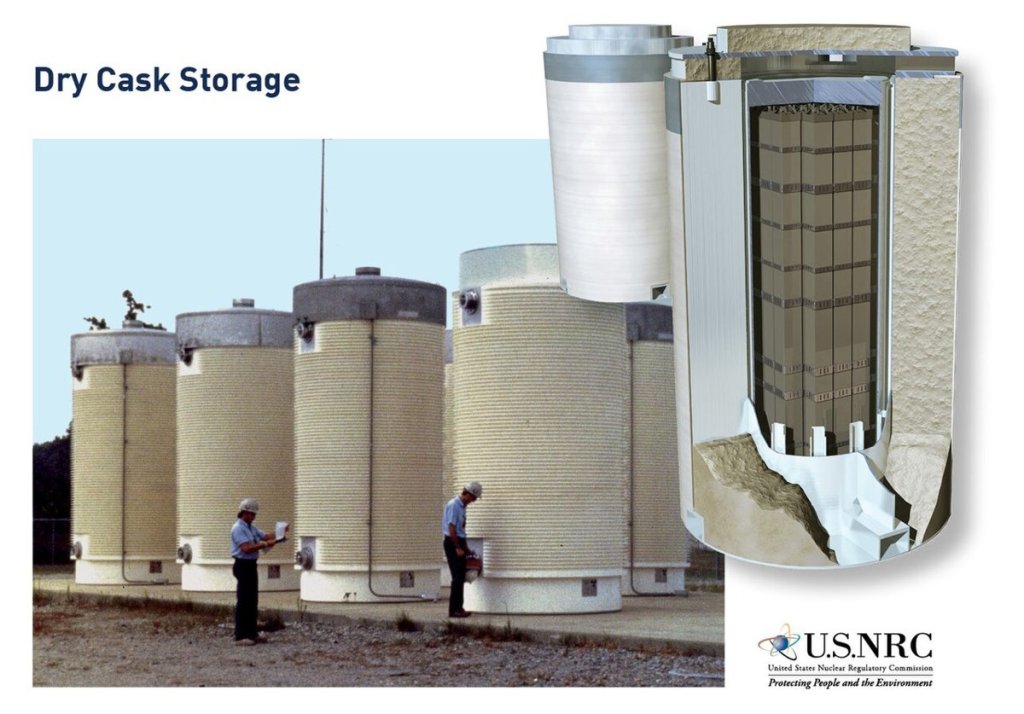
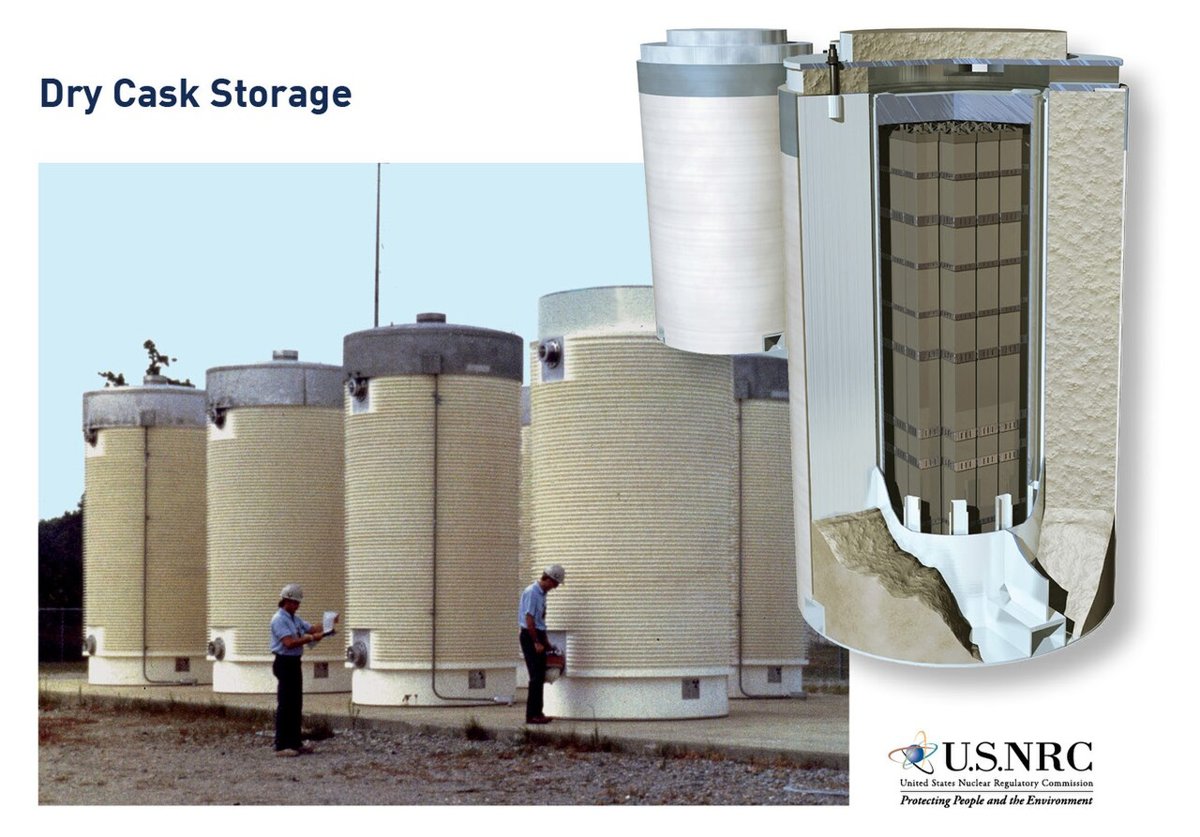
Wet pools and dry casks. wet storage uses stainless steel-lined pools, typically 12 meters deep, beside the reactor building; water shields and cools at once. After a minimum of about five years, depending on burnup, cask design, thermal limits and regulatory approval, assemblies move to dry cask storage: steel and concrete containers cooled by natural air circulation with no power supply. A boxed note gives the dimensions: 2–3 meters across, 4–6 meters tall, 10–37 assemblies per cask, NRC licenses of up to 40 years with renewal, and a design life well over 100 years. The United States holds more than 95,000 metric tons of spent fuel at about 79 sites in over 30 states, most of it in dry casks. The engineering is sound. The problem is that temporary storage, at some sites since the 1980s, has become the de facto long-term arrangement.
The political record. The Nuclear Waste Policy Act of 1982 made permanent disposal a federal responsibility and created the Nuclear Waste Fund, financed by a levy on nuclear electricity; its balance stood at about $52 billion in September 2024. Yucca Mountain in Nevada was designated in 2002: volcanic tuff in arid desert, about 300 meters above the water table, found technically suitable by DOE’s characterization program. The Obama administration withdrew the license application in 2010. The NRC licensing board ruled that DOE lacked authority to withdraw it, the DC Circuit ordered review to continue in 2013, and NRC staff finished the Safety Evaluation Report in 2015. Licensing adjudication and construction authorization were never completed. Utilities have won breach-of-contract claims, paid through the Treasury’s Judgment Fund, with recent liability estimates of $37–45 billion.
Finland and community consent. The Onkalo repository (“hiding place”) is under construction at Olkiluoto, next to a plant supplying about 30% of Finnish electricity. It completed trial runs with test canisters in 2024, and Posiva targeted 2026 for first fuel, pending an operating license from STUK. Onkalo uses the KBS-3 method: fuel in copper canisters with cast-iron inserts, surrounded by bentonite clay, in tunnels 400–500 meters down in crystalline bedrock. The municipality of Eurajoki voted in favor in 2000, a legal prerequisite, after decades of engagement. Sweden’s Forsmark, on the same method, won government approval in 2022 after a court challenge over copper corrosion modeling. The boxed comparison with Nevada is blunt: “The difference is the consent process.” Nevada had no nuclear community and a history of federal nuclear testing that created distrust.
The energy value. Calling spent fuel waste reflects the once-through cycle; “It is not a physical property of the material.” About 95–97% of spent fuel is U-238 and residual U-235, and a fast breeder cycle extracts about 60 times more energy per unit mass than once-through. US spent fuel contains roughly 89,000–91,000 metric tons of U-238 and about 950 metric tons of plutonium. With about 700,000 metric tons of depleted uranium, the total is about 790,000 metric tons of feedstock, roughly 500 years of US electricity at 4.0–4.4 thousand TWh a year. The chapter closes by sorting the material: the fission products are genuinely waste, the actinides are small in mass but long-lived, and the uranium and plutonium are an energy resource under a different policy framework.
Chapter 14 — Reprocessing
What reprocessing is. Reprocessing is the set of chemical separations that divide spent fuel into its streams, recycling uranium and plutonium and concentrating the hazardous remainder. It is proven. France’s La Hague facility in Normandy has run since the late 1960s, treating fuel from the French fleet and, under contract, from utilities across Europe and Japan. It has processed tens of thousands of metric tons and has about 1,700 metric tons a year of capacity. The US plant at West Valley, New York, processed about 640 metric tons between 1966 and 1972, shut for capacity modifications that were never completed, and never reopened.
PUREX chemistry. PUREX was developed in the United States in the late 1940s for the weapons program. Assemblies are chopped or sheared, and the fuel is dissolved in concentrated nitric acid inside heavily shielded remote cells. Separation uses two immiscible liquids: an aqueous phase holding the dissolved metals and an organic phase of tributyl phosphate (TBP) in a hydrocarbon solvent. TBP’s phosphoryl oxygen bonds to uranium and plutonium in their higher valence states, while trivalent fission-product ions partition less strongly, so fission products and minor actinides stay in the aqueous waste.
Splitting plutonium from uranium. A reducing agent, typically ferrous sulfamate or hydroxylamine, drops plutonium to a lower oxidation state. Plutonium then strips back into an aqueous solution while uranium stays in the organic phase. The outputs are purified uranium, a plutonium nitrate solution (not metal; conversion is a further step), and a high-level waste stream.
Where the streams go. The uranium stream, 94–96% of the original mass, can be re-enriched, but it carries U-236. A boxed note explains the constraint: U-236 is a neutron absorber made by capture in U-235, absent from natural uranium, that forces slightly higher enrichment. Centrifuges cannot reject it, and SILEX laser enrichment may reduce carryover but has not shown it at commercial scale. The plutonium, about 1%, becomes MOX, and France’s MELOX plant fuels about two-fifths of the French fleet as of 2024. Spent MOX is not currently recycled a second time. The waste stream goes to vitrification in borosilicate glass. “A fully closed cycle requires fast reactors.”
The Carter deferral. “The constraint on US reprocessing has been policy, not process.” In 1977 President Carter issued an executive policy statement indefinitely deferring commercial reprocessing, citing nonproliferation: separated plutonium nitrate can be made into weapons-usable metal or oxide without enrichment, and a US program might set a precedent. The Carter deferral had no statutory basis; a boxed note stresses that it was never a ban and that no statutory prohibition exists today. Reagan modified it in 1981 and left reprocessing to private industry, which never rebuilt the capability. The book calls the proliferation trade-off contested among arms control scholars, but says the deferral had material consequences, including more than 95,000 metric tons of unreprocessed fuel. The Savannah River MOX facility was cancelled in 2018 after about $7–8 billion spent, leaving no US commercial MOX or PUREX capability.
Pyroprocessing. Pyroprocessing is built so that plutonium never appears as a pure stream. Metallic spent fuel, the form used in EBR-II and planned for Natrium, is dissolved in a molten salt bath at about 500 °C; LWR oxide fuel first needs an electroreduction step. Current drives actinides onto a solid cathode while fission products stay in the salt. A second electrorefining step deposits uranium on a solid cathode and the mixed transuranics (plutonium, neptunium, americium, curium) on a liquid cadmium cathode. Isolating plutonium would need further chemical separation, subject to safeguards detection. The book calls the barrier meaningful but not absolute. South Korea has researched it with the United States, and it has reached pilot scale but not commercial operation.
What reprocessing cannot do. The high-level waste is still about 3–4% of the original mass and contains isotopes with half-lives of hundreds of thousands to millions of years. Fissioning the long-lived actinides in fast reactors could cut the isolation period to about 300 years, but only with high separation efficiency and multiple passes. France recovers uranium and plutonium but does not transmute, because it operates no fast reactors, which makes it “the clearest illustration of the gap between partial closure and full closure.”
Chapter 15 — Fast Breeders
The resource equation. Reprocessing only partially closes the cycle. U-238, 99.3% of all uranium, does not fission efficiently in a thermal spectrum, but it can capture a neutron and become fissile plutonium-239. In a fast reactor that conversion runs efficiently. If the reactor makes more fissile material than it consumes, depleted uranium and spent fuel inventories become the primary energy reserve.
The physics of breeding. The chapter sets out three linked mechanisms. Fission of the core, mainly plutonium-239, releases energy and fast neutrons. U-238 in the surrounding fertile blanket captures surplus neutrons and becomes uranium-239 (U-239), which decays to neptunium-239 and then to plutonium-239. The two steps take about 2.5 days, dominated by neptunium-239’s 2.36 days. Reprocessing then recovers the bred plutonium for new fuel. The breeding ratio counts Pu-239 atoms produced per fissile atom destroyed. Thermal reactors sit below 1.0, a ratio of exactly 1.0 holds inventory constant, and above 1.0 is a true breeder. Breeding needs fast neutrons, an adequate blanket, efficient reprocessing and low parasitic absorption. Sodium-cooled fast reactors reach 1.1–1.4.
Russia leads. The technology has run in operating reactors over six decades. Russia’s BN-800 at Beloyarsk, operating since 2016, moved to a full MOX core in 2022 and breeds at about 1.0, on the converter-to-breeder boundary. The BN-1200M, also at Beloyarsk, received a construction license in 2025, with first concrete scheduled for 2027. It targets a breeding ratio of about 1.4, with nitride fuel for multi-recycling and pyroprocessing at the Proryv facility at Seversk. The book calls it “the most coherent national commitment to the closed cycle.”
China, India and the United States. China’s CFR-600, a 600 MW sodium-cooled reactor at Xiapu developed with substantial Russian assistance, began initial operations in late 2023; full grid connection was not publicly confirmed as of 2025–2026. India’s Prototype Fast Breeder Reactor at Kalpakkam reached first criticality in April 2026, with commercial operation targeted for late 2026; it is Stage 2 of the three-stage program. TerraPower’s Natrium, under construction at Kemmerer, Wyoming, treats a closed cycle with pyroprocessing as a design assumption that shapes its metallic fuel.
Doubling time. The breeding ratio is measured per fuel cycle. A ratio of 1.2 means 20% growth per cycle, and a cycle of three years in the reactor plus two for reprocessing and refabrication lasts five years. doubling time, the time for one breeder to fuel a second, runs 15–30 years for realistic designs. At a 20-year doubling time, a growing fleet reaches fissile self-sufficiency in 40–60 years, or two to three doublings, which is Chapter 27’s roadmap. The deployment horizon is the binding constraint.
The US stockpile, worked. About 700,000 metric tons of depleted uranium sit at the former gaseous diffusion sites in Ohio and Kentucky, beside more than 95,000 metric tons of spent fuel. Together they hold about 795,000 metric tons of U-238 and about 950 metric tons of plutonium. The baseline is about 45 GWh of electricity per metric ton of natural uranium once-through (World Nuclear Association and IAEA data). An LWR exploits only 0.5–0.8% of its heavy metal, at about 33% efficiency. A breeder’s 60× multiplier gives about 2.7 TWh per ton. Applied to about 785,000 metric tons, that is about 2.1 million TWh, or roughly 500 years at 4,000 TWh a year. A boxed caveat says this assumes mature technology but that the order of magnitude is robust. Forecast supply deficits in the 2030s and 2040s are a real constraint in a world without breeders; in a world with them, the stockpiles become the primary resource.
Transmutation. The same fast neutrons can fission the long-lived minor actinides. Americium-241, americium-243, neptunium-237 and curium-244 are among the main contributors to radiotoxicity beyond 300 years. Significant reduction takes multiple passes, so the 300-year figure depends on very high separation efficiency. France’s Astrid program, meant for this mission, was cancelled in 2019 as a budget decision. La Hague’s separated actinides now go into vitrified waste, and the 300-year timescale “remains aspirational rather than achieved.”
The policy question. No integrated closed-cycle system of fast reactors and reprocessing runs at global scale, though France and Russia operate partial elements. The technology exists. Building it at commercial scale is the challenge the 40–60 year transition describes.
Chapter 16 — Nuclear Waste
Classified by activity. Nuclear waste ranges from lightly contaminated protective clothing to spent fuel and vitrified glass canisters. Regulators classify it by activity level and management requirement. High-level waste needs geological disposal at depth, ILW (intermediate-level waste) engineered disposal at moderate depth, and LLW (low-level waste) engineered near-surface disposal. The same isotope can fall in different categories depending on concentration. HLW is about 3% of total waste volume in most national inventories but holds about 95% of the radioactivity. Everything said about the long-lived hazard applies to that 3%.
Volume. More than sixty years of US nuclear power, 93 reactors supplying about 19% of national electricity, has produced more than 95,000 metric tons of spent fuel in total. US coal produced about 130 million metric tons of combustion products a year at its early-2010s peak. A single year’s coal residuals still exceed the whole cumulative spent-fuel inventory by a factor in the hundreds. The book is careful that this shows nothing about hazard per unit mass, where nuclear waste is far more radioactive. Its point is that a small, concentrated volume can be fully accounted for. All US spent fuel is monitored and contained under NRC license, while a significant number of coal ash sites have documented groundwater contamination concerns under EPA’s coal combustion residual program.
The radioactivity timescale. The radioactivity timescale is the second dimension. Fission products reach levels comparable to uranium ore in about 300 years. Actinides such as plutonium-239, neptunium-237 and americium-241 persist for hundreds of thousands to millions of years. The 300-year horizon applies only after substantial transmutation over multiple fast reactor cycles, which exists nowhere at commercial scale, so today’s repositories must be designed for the longer period. Universities, religious bodies and national governments have lasted for centuries. The book treats 300 years and 300,000 years as qualitatively different problems: one that repositories and institutions can plausibly manage, and one that stretches institutional reliability to its practical limits.
Geological disposal. The technical consensus is the deep geological repository, at depths of 300–1,000 meters behind multiple barriers, studied for more than fifty years. In the KBS-3 design, copper resists corrosion in the reducing, oxygen-poor environment of deep bedrock, and bentonite swells when wet, filling voids and slowing radionuclide migration. Onkalo is the first spent-fuel repository to move through construction toward operation. Forsmark’s 2022 approval came with conditions on canister performance monitoring. France, Switzerland and others are at earlier stages. The book’s judgment is that in the leading programs the remaining obstacles are often social, political and licensing-related.
Low- and intermediate-level waste. By IAEA classification, LLW and ILW are roughly 97% of radioactive waste by volume: tools, clothing, filter resins, reactor components and decommissioning debris, with half-lives measured in decades. near-surface disposal in engineered facilities is accepted practice in most nuclear countries. Local concerns about transport, decommissioning volumes and siting are real, but the management approach is established.
$52 billion. The Nuclear Waste Fund held about $52 billion in September 2024. DOE spent about $15 billion on site characterization and the Yucca Mountain application before the 2010 withdrawal. Damages for the government’s failure to take spent fuel are paid from the Judgment Fund, and DOE liability figures keep rising with new judgments. A federal circuit court suspended fee collection in 2014. As of 2026 neither a Yucca revival nor an alternative site has been settled, and the site’s scientific basis has not been overturned.
Accelerated decay. decay rates are set by nuclear forces and, under ordinary conditions, do not depend on chemistry or temperature. The exception is highly ionized atoms, as in a plasma, because some decay pathways depend on orbital electrons. Intense laser pulses can produce such states in small targets, and laboratory work has shown small changes in decay rates. The threshold that matters is processing significant quantities of specific isotopes, far beyond any demonstration. The book treats this as early-stage research into a physically grounded concept.
Where the Part leaves things. The technical picture is small volumes, established storage, repository programs in development and transmutation under research. The policy picture is unresolved: Yucca Mountain is stalled, the US has no reprocessing, and fast reactors are early in the West, with Russia running BN-series reactors and India advancing the PFBR. Part Five turns to the supply chains around the fuel cycle: helium, isotopes, critical materials, the nuclear industrial base and the maritime frontier.
Supporting appendices
- Appendix XII — Physics and Mathematics. The decay-law section shows that ten half-lives leave 1/1024 ≈ 0.1%, the basis of the 300-year statement; its half-life table runs from Cs-137 (30.1 years) to Np-237 (2,144,000 years). It covers the Bateman equations and the Way-Wigner decay-heat approximation, P/P₀ ≈ 0.066 × t⁻⁰·², which gives 20.4 MW one day and 4.5 MW five years after shutdown of a 3,000 MWth reactor. The breeding section derives BR ≈ η − 1 − L − A (1.32 for a sodium-cooled reactor) and doubling times of 15–30 years from DT ≈ cycle time/(BR − 1). It works the 500-year estimate as 785,000 MT × 2.7 TWh/MT ≈ 2.1 million TWh, about 530 years.
- Appendix XIII — Optional Problem Set. A reference cask (24 PWR assemblies, 10 MT heavy metal, 45 GWd/tHM) runs through Layer 2: 2-0 The Iodine-Xenon Chain (Bateman warmup), 2-1 The 300-Year Threshold (0.098% of Cs-137 remains after 300 years, 99.99% of Np-237), 2-2 Decay Heat and the Cooling Requirement, and 2-S What Is in the Cask Now? (about 11 kg of Am-241 and 24.3 TWh of breeder value per cask). 1-S The Plutonium in Our Cask finds about 66% of bred Pu-239 fissioned before discharge, and 3-S The Closed Cycle Case derives a 20-year doubling time and confirms the 500-year figure.
- Appendix X — Industry and Landscape. The “Waste Management, Decommissioning, and Environmental Remediation” and “Reprocessing and Recycling” categories map the back-end industry, from La Hague and Mayak to Rokkasho.
- Appendix VIII — Glossary of Terms gives working definitions, with the chapter of first use, for every term marked here. Appendix IX — Regulatory and Policy Timeline places the Carter deferral (1977), the Reagan reversal (1981), the Nuclear Waste Policy Act (1982), the 2002 Yucca Mountain recommendation, the BN-1200M license (2025) and PFBR criticality (April 6, 2026) in sequence.
Longer technical notes and Top Stories tagged to Part IV will appear on this page as they are published.


Leave a Reply