It May Be Time to Optimize Nuclear Fuel Again
Jeff Hill • From The Nuclear Fuel Cycle: A Complete Primer • Version 5 — 17 October 2026
Abstract
The enrichment of commercial reactor fuel is a design variable, not a constant. For most of the nuclear era it has been held at or below about 5 percent uranium-235, and the fuel cycle was built around that ceiling. There is no fission threshold at 5 percent. The boundary records the range in which the industry matured. This paper argues that the variables around it have moved enough — enrichment energy cost down by more than an order of magnitude, reactor lives toward eighty years, outage value up — that the optimization should be run again. It establishes that the first increment is already underway, in a bounded form: four lead test assemblies at up to 6 percent in one operating U.S. pressurized-water reactor, a commercial reload contract not yet irradiated, and limited production of material between 5 and 10 percent. It does not establish that any equilibrium core has been converted, that 19.75 percent material belongs in a large light-water reactor, or that a higher assay is better by definition. Higher enrichment buys reactor service with additional separative work. It earns its place only where that trade improves lifetime cost per megawatt-hour.
A commercial light-water reactor in the United States shuts down every eighteen to twenty-four months to replace a portion of its fuel. A modern American submarine carries enough fuel to operate for essentially the service life of the ship: the reactor core being developed for the Columbia-class ballistic-missile submarine is intended to last more than forty years without refueling. Both are light-water reactors. Both use ordinary water as coolant and moderator, and both obtain their energy from the fission of uranium-235. Their designers arrived at radically different answers to an apparently simple question — how much U-235 the fuel should contain.
The difference is not that naval engineers discovered different physics. They were solving a different optimization problem. For a commercial power reactor, fuel cost matters, enrichment cost matters, and fabrication and transport cost matter; the plant can be taken offline, refueled within weeks, and returned to service. For a submarine, refueling removes a strategically valuable ship from service for an extended shipyard overhaul, and the reactor must fit inside a hull where every cubic meter and every tonne carries extraordinary value. The submarine optimization therefore moves toward very high energy density and very long core life, and accepts highly enriched uranium and a specialized fuel system to obtain them. Eliminating the midlife refueling overhaul is part of what allows twelve Columbia-class submarines to carry a strategic mission that previously required fourteen Ohio-class boats [28]. Force sizing also depends on patrol tempo, maintenance and overhaul duration, and how many boats must be available at sea at any given time; the life-of-ship core helps on the availability side of that calculation, it does not by itself set the number twelve.
Nobody is proposing that commercial reactors adopt naval fuel. The economics, safeguards obligations, reactor designs and missions are fundamentally different. The comparison exposes something easy to overlook. The enrichment of reactor fuel is not a constant of nature. It is a design variable whose optimum depends on what the reactor is asked to do. For most of the commercial nuclear era that variable has been held at or below about 5 percent U-235, and the engineering has been done around it. The variables surrounding that boundary have now changed enough to justify running the optimization again.
How Five Percent Became Normal
There is no threshold in the fission cross-section data at 5 percent U-235. The boundary records the operating range in which the commercial fuel cycle matured and the licensing basis that grew up around it — fabrication, transport, criticality safety and storage. That 5 percent figure is not a single rule. It is embedded across the regulatory patchwork: in 10 CFR Part 50 licensing practice and NRC-approved methods for operating reactors, including the fresh-fuel criticality requirements of 10 CFR 50.68, which set a maximum nominal enrichment of 5.0 weight percent for the fuel assemblies to which they apply [13][14]; in fabrication, where enriching, converting and manufacturing fuel above that range must be authorized under 10 CFR Part 70 licensing and its criticality-safety basis; in transport under 10 CFR Part 71, including provisions such as §71.55(g) that are written around uranium enriched to no more than 5 weight percent [15]; and in the criticality benchmarks and analyses used for fresh- and spent-fuel storage. Moving beyond 5 percent therefore requires re-analysis and requalification across the whole fuel cycle, and, as applicable, a plant-specific license amendment or the NRC’s increased-enrichment rulemaking [13] — not the discovery of different physics. The 20 percent line between low-enriched and highly enriched uranium is a separate, nonproliferation boundary and is not at issue here.
Moving it is a matter of re-analysis and requalification across the whole fuel cycle, as set out above, not of discovering different physics.
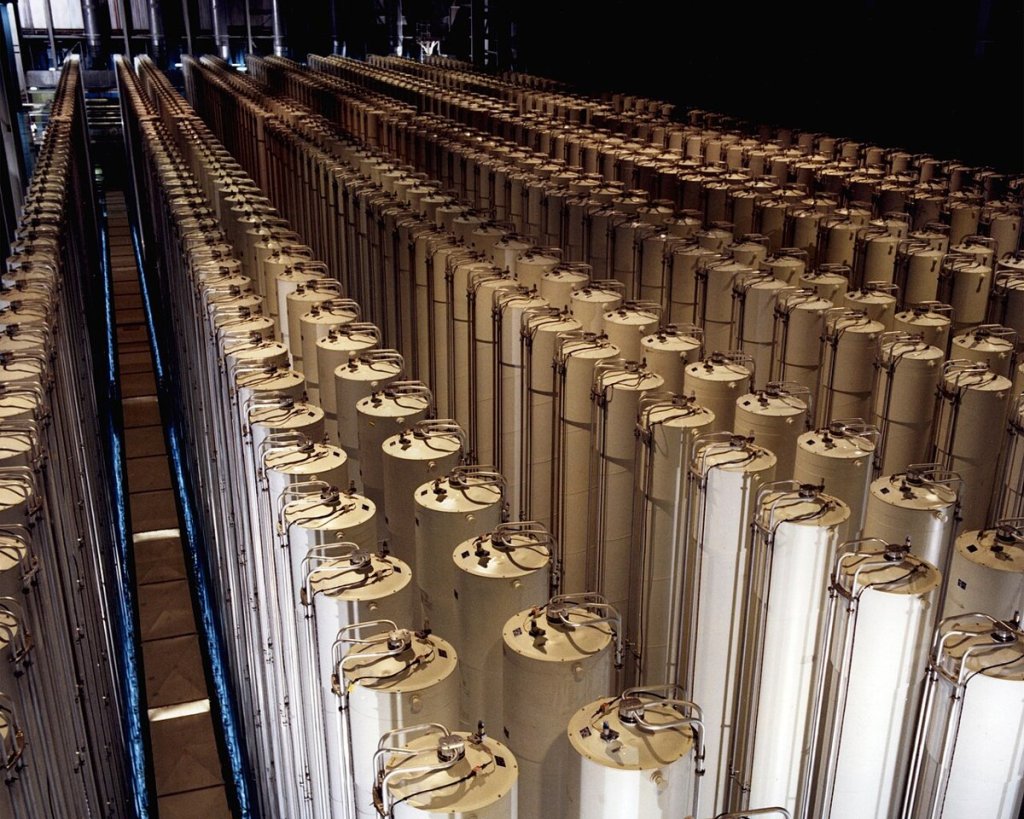
Enrichment technology at the time that range was established was also very different. The first commercial-scale American enrichment was gaseous diffusion, developed for the wartime weapons program. Uranium hexafluoride gas is forced through porous barriers; molecules carrying U-235 are fractionally lighter and pass slightly more readily, and the enrichment achieved per stage is so small that reaching reactor-grade product requires more than a thousand stages in series. The US diffusion plants at Oak Ridge, Paducah and Portsmouth were among the largest industrial buildings ever constructed, and the process consumed roughly 2,400 kilowatt-hours of electricity per separative work unit, or SWU — the standard measure of the effort required to separate uranium isotopes. [16][17]
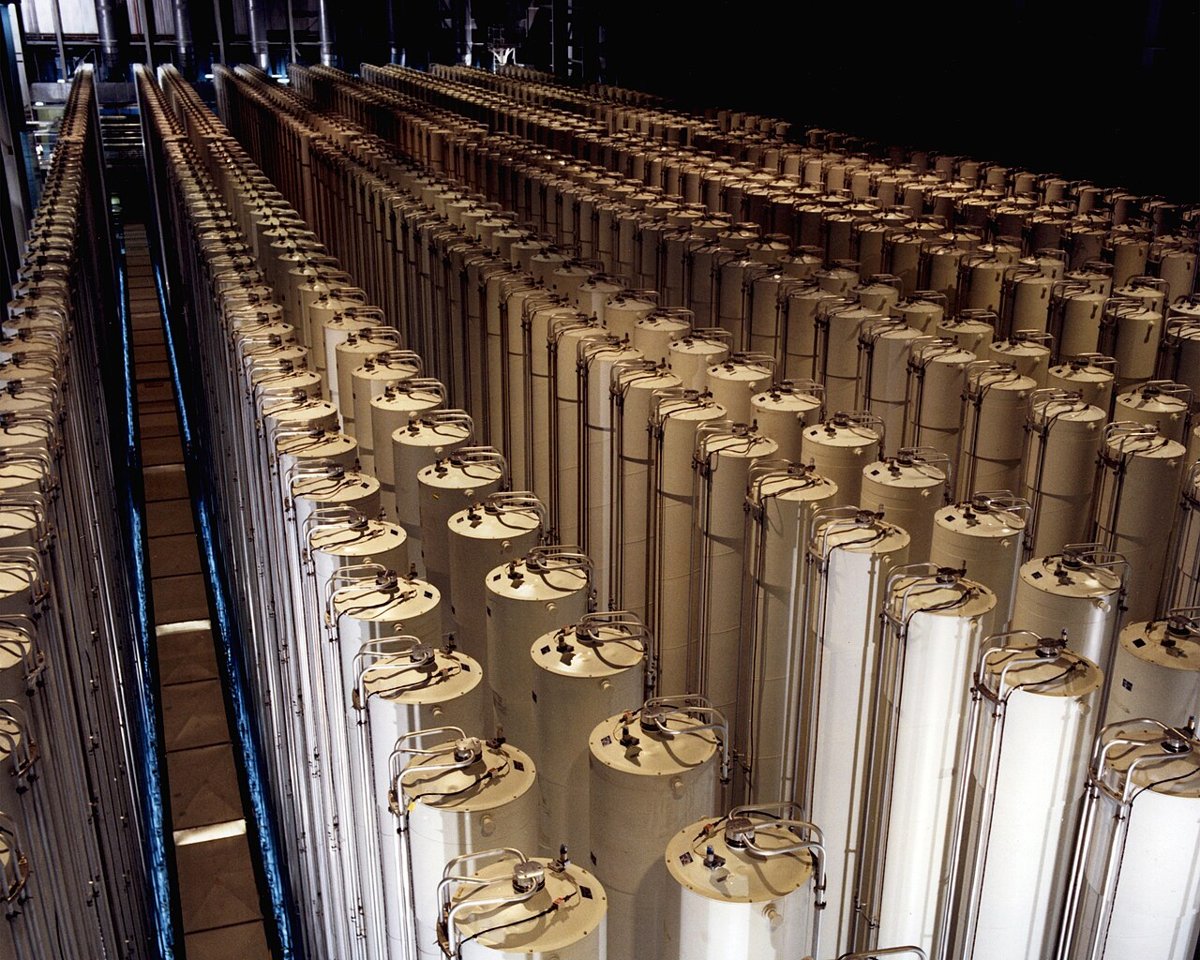
The gas centrifuge changed that calculation. Spinning UF₆ at peripheral speeds approaching the speed of sound drives the heavier U-238-bearing molecules toward the rotor wall and concentrates U-235 toward the axis, with far fewer stages and about 50 kilowatt-hours per SWU — roughly a fiftieth of the diffusion figure. The centrifuge displaced diffusion at every major enricher from the 1970s onward, and the last US diffusion plant, at Paducah, stopped enriching in 2013. A change of that size in one of the fuel cycle’s fundamental inputs is not an incremental improvement.
A further change may follow. Laser isotope separation, pursued since the Cold War, discriminates between isotopes by their optical or electronic properties rather than by their small difference in mass. Atomic Vapor Laser Isotope Separation reached an advanced stage at Lawrence Livermore National Laboratory in the 1970s and 1980s, far enough that USEC was preparing to build a commercial plant when the program was terminated in 1999. Cheap Russian enrichment supply had removed much of the economic case, and the program’s commercial readiness, plant economics and engineering scale-up were also contested; it was not a demonstration that the physics had failed, and it was not proof that a commercial plant was ready either [18]. Several laser approaches are now moving toward commercial demonstration again, some operating on UF₆ and others, in the AVLIS lineage, on uranium metal vapor. Their projected energy consumption is in the range of 10 kilowatt-hours per SWU or less [19]. Those figures remain projections: no laser uranium-enrichment process has yet demonstrated sustained commercial-scale operation, and the centrifuge remains the established benchmark. A reactor strategy should not depend on laser enrichment succeeding. The point is narrower and more durable. The cost and technical architecture of enrichment are themselves variables, and they have already moved once by more than an order of magnitude since the commercial fuel regime took shape.
Clean Sheet
Suppose a young nuclear engineer is given a clean sheet of paper and asked to design a 1,200-MWe pressurized-water reactor intended to operate for eighty years, in a power system that values reliable electricity, with modern enrichment technology available and the fuel cycle designed alongside the reactor rather than inherited. Safety requirements are fixed and non-negotiable, as are safeguards and material-security obligations. Enrichment is not specified in advance.
She would not begin with enrichment. She would begin with the service required of the reactor and work backward: how much power it should produce, how long it should operate between refueling outages, how much energy should be extracted from each tonne of fuel before discharge, what thermal and mechanical limits the fuel must respect, what shutdown margin is required, and how the core behaves in normal operation, anticipated transients and accidents. One of the first variables she would meet is burnup — the energy extracted from a given mass of fuel, conventionally expressed in gigawatt-days per metric tonne of uranium, GWd/MTU. Burnup and cycle length are related but distinct. Cycle length measures time between refueling outages; burnup measures how thoroughly the fuel itself has been used.
Current US commercial fuel operates within burnup limits of roughly 62 GWd/MTU under existing NRC-approved methods. Fuel vendors and utilities are now investigating 75 to 80 GWd/MTU, and at the same time exploring enrichment above 5 percent and toward 10 percent. The two developments are connected. Additional initial U-235 inventory is what allows a core to support higher burnup, longer cycles, different reload strategies and greater flexibility in power shaping, and it can compensate for the neutronic penalty that some accident-tolerant cladding and fuel materials impose. [26][29]
She would therefore run the design repeatedly — at 4 percent, 5, 6, 7 and 8 — and at each point she would redesign the core rather than load richer fuel into an unchanged one. Assembly loading, enrichment zoning, burnable absorbers, reload fraction, power distribution, neutron leakage, control-rod worth and thermal margins all change with the assay. She would then carry each candidate through the rest of the fuel cycle: the natural uranium it requires, the conversion capacity and separative work, the fabrication cost and criticality controls, the transport requirements, the number of fresh assemblies over the life of the plant, and the number, burnup and decay heat of the spent assemblies that emerge and must be stored and eventually disposed of.
Only then could she ask which enrichment is best, and the answer would not be a single number but a curve. At low enrichment, fuel is comparatively cheap to produce, but shorter cycles and lower achievable burnup mean more fuel throughput and more frequent outages of an expensive machine. As enrichment rises, cycles can lengthen and each loading can yield more energy. Continue upward, and the cost of additional separative work climbs steeply, criticality control, fabrication, transport and the back end grow more demanding, and fuel-performance limits cap the burnup that more U-235 can buy. Somewhere between those effects lies an economically attractive region, bounded throughout by the safety requirements. Nothing in the physics places the bottom of that region at precisely 5.00 percent, and nothing in the historical boundary tells us where it lies today.
The Naval Endpoint
Give the same engineer a different assignment — a reactor that must fit inside a submarine hull, deliver propulsion and electrical power under demanding conditions, and avoid the enormous penalty of cutting the ship open in mid-life to refuel it — and the optimization moves to the far end of the curve. The progression of naval cores, from the first generation that ran a few years between refuelings to the Columbia-class life-of-ship core, did not happen because enrichment became the only variable that mattered. It happened because fuels, materials and reactor design evolved together around an unusually demanding service requirement, and because the value the Navy assigns to compactness and uninterrupted availability is high enough that spending heavily on the core is rational.
A commercial reactor has no need of a forty-year core. Carrying decades of excess fissile inventory to avoid an outage that can be completed in weeks would make no sense, and civilian safeguards, fabrication, transport and economics make naval enrichment inappropriate in any case. The naval example does not establish the right enrichment for a power reactor. It establishes a principle: fuel cost should not be optimized independently of the asset the fuel serves. Civilian reactors historically sat at one end of the curve, accepting periodic refueling in exchange for inexpensive fuel; naval reactors sit at the other. A large design space lies between them.
Value of the Reactor
Consider a nominal 1,100-MWe reactor taken offline for a 25-day refueling outage. The generation forgone is roughly 660,000 megawatt-hours. At $50 per megawatt-hour that represents about $33 million of gross electricity value; at $75, almost $50 million. These figures are not lost profit. Maintenance must still be performed, prices vary by hour and location, and not every outage day removed from refueling becomes an additional day of generation. But the arithmetic shows the scale of the machine whose availability is being traded against the cost of its fuel.
That machine has become more valuable. Many US reactors are licensed or seeking licenses to operate for as long as eighty years. Utilities are again pursuing power uprates, which raise the value of every day the plant is online. Electricity demand is rising while new firm, non-weather-dependent capacity remains difficult and expensive to build. This was not the situation a decade ago, when low natural-gas prices drove several US reactors into early retirement and a reactor-day was correspondingly cheap.
The historical commercial optimum may therefore be moving from both directions. The energy required to perform separative work has fallen by more than an order of magnitude since diffusion, while the value of reactor availability has risen. Centrifuges made separative work far less energy-intensive decades ago, but for much of that period the reactor time that higher enrichment would have bought was not worth enough to justify requalifying an entire fuel cycle. Neither observation proves that 7 percent fuel is better than 5 percent fuel.
The First Increment
In one sense the calculation is already being run. In April 2025 Southern Nuclear loaded four Westinghouse lead test assemblies into Vogtle Unit 2, containing fuel enriched to as much as 6 percent U-235 — the first irradiation of fuel enriched above 5 percent in a US commercial power reactor. The reactor is a Westinghouse four-loop pressurized-water reactor that entered commercial operation in 1989. It is not an AP1000. Units 3 and 4 at the same site are the AP1000s. Unit 2 has 193 fuel assemblies. Four of them are in the test. The remainder of the core continues on fuel within the plant’s previously authorized enrichment range. [1][3][4]
Authorization came in October 2023, limited to those four assemblies at up to 6 percent. The assemblies contain Westinghouse ADOPT pellets — doped uranium dioxide, with small additions of chromia and alumina intended to raise uranium density while limiting the parasitic absorption of chromium — together with chromium-coated cladding and AXIOM cladding. The uranium oxide powder was prepared at Idaho National Laboratory, and the test sits under the Department of Energy’s accident-tolerant-fuel program. The assemblies are to be examined over several cycles, on the order of four and a half years, before the results can support a broader commercial case. A lead-test authorization is a bounded experiment. It is not a license to convert the core. [2][1]
A second step has a commercial counterparty but has not yet been irradiated. In September 2026 Framatome announced a contract to supply a US operating reactor with a reload enriched above 5 percent, intended to move that unnamed customer from an 18-month cycle to a 24-month cycle, with first delivery in spring 2028 [6][7]. Framatome’s Richland fabrication plant had, by then, received NRC authorization to fabricate fuel above the historical 5 percent ceiling — in May 2026 for light-water-reactor fuel — including a further July 2026 amendment covering fabrication up to 10 percent for advanced-reactor fuel [8]. A contract is not an irradiated core. [6][7][8]
The enrichment side of the same increment is no longer only a paper authorization. In September 2025 the NRC authorized Urenco USA, at Eunice, New Mexico, to enrich up to 10 percent U-235. In December 2025 that plant completed its first production run above 5 percent, at 8.5 percent. In May 2026 Urenco’s Capenhurst plant in England completed a five-day trial, authorized by the Office for Nuclear Regulation, that produced samples at 7 percent. Production and a trial are not a fleet reload. They are the front-end counterpart to the Vogtle assemblies: the assay can now be made, in limited quantity, on both sides of the Atlantic. [9][10][11][12]
Status as of 17 October 2026
Four lead test assemblies, up to 6 percent, in Vogtle Unit 2 — a Westinghouse four-loop PWR, not an AP1000. Authorization October 2023; loading April 2025. Not a core conversion. Framatome announced a commercial above-5-percent reload contract in September 2026; the customer was not named, and the fuel has not been irradiated. Urenco USA was authorized to 10 percent in September 2025 and completed a first production run at 8.5 percent in December 2025. Capenhurst completed a 7 percent trial in May 2026. No licensed equilibrium LEU+ core is in evidence for an AP1000 or an APR1400. The APR1400 evidence is a 2023 core-design study, not a commercial program. These facts will move. The argument will not.
None of this is a conversion of the existing fleet, and none of it is 19.75 percent HALEU. The relevant band for operating light-water reactors is the increment just above the present ceiling — roughly 5 to 10 percent, which industry has begun to call LEU+. Under the statutory definition used in the United States, anything above 5 percent and below 20 percent is high-assay low-enriched uranium. The two labels overlap. They do not describe the same end use. The NRC’s own account identifies 5 to 10 percent as potentially applicable to operating light-water reactors, and 5 to 20 percent as the range proposed for many advanced non-light-water designs. [24][25]
There is no neutronic prohibition on sustaining a chain reaction with uranium enriched above 5 percent in a PWR lattice, including an AP1000 or an APR1400. That is the easy half of the claim. The hard half is qualification: a fuel system qualified at the new enrichment and the intended burnup; a core design inside power-distribution, shutdown-margin and burnable-poison limits; a safety analysis rewritten for the new fuel, including loss-of-coolant behavior; a license amendment, because current US practice treats 5 percent as the ceiling unless additional analysis is approved; a fabrication plant authorized for the assay; transport and fresh-fuel storage that remain subcritical; and a spent-fuel calculation for the changed decay heat, isotopic inventory and criticality. For the APR1400, the public evidence of that work is the 2023 study noted above. [23]
The extra fissile material can be spent in more than one way, and the uses are not the same decision. Longer cycles are the stated target of the higher-enrichment and accident-tolerant-fuel programs: 24 months in place of 18. Higher burnup is related but distinct; additional initial U-235 is what supplies the inventory to reach 75 to 80 GWd/MTU. Power uprates can use the same inventory only if the steam supply, turbine-generator, safety systems and licensing basis can accept a higher thermal output. The NRC has approved more than 170 uprates over the decades; what is newer is the proposal to couple them to higher enrichment and accident-tolerant fuel. Utilities have expressed interest in uprates and in that enabling package. A 2026 core study from the University of Wisconsin–Madison and the University of Michigan examined the stretch case directly: enrichment up to 10 percent, a lead-pin discharge burnup limit of 80 GWd/t, chromia-doped fuel with chromium-coated cladding, a 24-month cycle, and a 20 percent power uprate. The authors reported configurations that stayed inside the assumed limits. It is a design-space result. It is not a licensed plant. [21] [22]
Some accident-tolerant materials improve high-temperature behavior and absorb more neutrons than the zirconium and uranium dioxide they replace. Higher enrichment can pay that penalty. And a PWR core is not one batch. It is assemblies of different ages, enrichments and poison loadings. A transition need not be an all-8-percent core. The likely path is a small number of higher-assay assemblies, then a zoned reload, then an equilibrium cycle. That is how the Vogtle test is structured. Six percent is a long way from naval enrichment, and that is what an optimization process should look like.
Price of the Next Percent
The engineer’s question is not how high the fuel can be enriched. It is what the next increment allows the complete system to do that it could not do economically before. That question imposes discipline, because modern enrichment does not repeal the arithmetic of isotope separation. Using natural feed at 0.711 percent U-235 and a tails assay of 0.3 percent — the convention used in The Nuclear Fuel Cycle — producing one kilogram of 5 percent product requires about 7.2 SWU and 11.4 kilograms of natural uranium. At 8 percent the figures are about 13.2 SWU and 18.7 kilograms: roughly 83 percent more separative work and 64 percent more feed per kilogram of fuel.
SEPARATIVE WORK AT HIGHER ASSAY. Requirements per kilogram of enriched product, from 0.711 percent natural feed at 0.3 percent tails, and per gigawatt-day of thermal energy at the illustrative burnups shown.
| Product assay | SWU per kg | Natural U per kg | Burnup (GWd/MTU) | SWU per GWd(t) | Natural U per GWd(t) |
|---|---|---|---|---|---|
| 5% | 7.2 | 11.4 kg | 62 | 116 | 184 kg |
| 6% | 9.2 | 13.9 kg | — | — | — |
| 8% | 13.2 | 18.7 kg | 80 | 165 | 234 kg |
| 10% | 17.3 | 23.6 kg | — | — | — |
Per-energy figures are shown only for the 5 and 8 percent cases discussed in the text. The ratios between them move by less than a percentage point if the tails assay is set at 0.25 percent. The burnup pairing is illustrative; the burnup achievable at a given assay is itself an output of core design.
Higher burnup offsets part of that increase, because fewer kilograms of fuel are needed for a given amount of energy. If achievable burnup rises from 62 to 80 GWd/MTU, energy per kilogram rises by about 29 percent. The offset is real but partial. Per unit of energy delivered, 8 percent fuel in this illustration still requires about 42 percent more separative work and about 27 percent more natural uranium than 5 percent fuel at today’s burnup limit.
That result clarifies what is being purchased. LEU+ is neither an enrichment-saving nor a uranium-saving technology. It is an asset-utilization technology: it purchases additional service from an expensive reactor by consuming additional enrichment work. The relevant comparison is therefore not the cost of 5 percent fuel against the cost of 8 percent fuel — the latter will always cost more — but total lifetime system cost per megawatt-hour at one enrichment and core design against the same quantity at another. Higher-assay fuel earns its place where the additional lifetime value from longer cycles, higher burnup, improved fuel management, greater availability and any enabled power increase exceeds the additional cost imposed on enrichment, fabrication, transport and the back end.
The Bottleneck
The cost side of that comparison is where the argument meets its most immediate constraint. The Western nuclear industry does not have surplus enrichment capacity. Existing reactors require conventional LEU, new large reactors will require more, many advanced reactors expect LEU+ or HALEU, and the United States and its allies are simultaneously replacing Russian enrichment services under an import ban that takes full effect in 2028. Replacement supply is costing more than Russian supply did. The low energy intensity of centrifuge separation is a long-run, structural feature of the technology; the price of a SWU in any given year reflects the capacity available to supply it. At present that capacity is scarce, and a fleet that begins demanding more SWU per unit of energy — 42 percent more in the illustration above — tightens it further. [20]
LEU+ therefore has an unusual economic character. It can improve utilization of the reactor while increasing demand on one of the fuel cycle’s most constrained stages. That is not a reason to reject it. It is a reason to sequence it: build enrichment and supporting fuel-cycle capacity first, or at least concurrently, and allocate higher-assay fuel where its system value exceeds its incremental fuel-cycle cost. Otherwise improving the reactor merely moves the bottleneck upstream.
The same constraint runs downstream of the cascade. Fabrication, transport, fresh-fuel storage, reactor analysis, spent-fuel pools and dry casks were engineered for a 5 percent assumption; each requires new criticality controls, methods or license amendments before it can accept the higher assay. Fuel fragmentation, relocation and dispersal under loss-of-coolant conditions become more important as rod burnup rises. As of September 2026, two pathways have been approved for applicants to address that behavior: a Framatome topical method for increased burnup [26], and EPRI’s Alternative Licensing Strategy [27]. Pathways are not fleet approval. They are the difference between an open technical question and a question with a defined way to close it. [26][27][29]
After Discharge
Higher burnup extracts more energy before a fuel assembly leaves the reactor and can reduce the number of assemblies discharged for a given quantity of electricity. The assemblies that do emerge have been irradiated more intensively, with different decay heat and isotopic inventories that storage, transport and disposal must account for. They also expose a larger question. Spent light-water reactor fuel still contains uranium, plutonium and other transuranic material capable of producing additional energy in suitable reactor and fuel-cycle systems. Higher burnup does not eliminate that potential; it moves the material further along the path before the light-water reactor is finished with it.
Recycling that material is not automatically economic. Reprocessing introduces difficult separations, fabrication, safeguards and waste-management problems; fast-spectrum reactors bring their own engineering, economic, security and regulatory requirements; and geological disposal remains necessary under any fuel cycle. But the principle that justifies additional enrichment applies here as well. If it is rational to spend additional separative work to extract more energy before discharge, it is reasonable to ask whether discharge must permanently mark the end of the material’s useful life.
Two developments make that question more interesting. Fast-spectrum reactors can use material that thermal reactors exploit poorly and, in breeding configurations, convert fertile U-238 into additional fissile material. Laser enrichment, described above as a possible change in separative work, adds a more specific possibility at the back end. Uranium recovered from spent fuel contains roughly 0.4 to 0.5 percent U-236, a neutron absorber produced in the reactor that forces a compensating increase in U-235 enrichment when the uranium is recycled. Centrifuges separate by mass and cannot reject U-236 selectively; it concentrates alongside U-235 in the product. Laser processes, operating on isotope-specific properties rather than mass, can in principle reject it. The capability has not been demonstrated at commercial scale, but it would bear directly on the value of reprocessed uranium.
None of these technologies needs to be economically compelling today for the option to have value. Spent fuel can be stored safely while a repository is developed, and the ability to recover useful material can be preserved until the system economics show whether it is worth exercising. It is the same principle at the back end as at the front: preserve the useful options, and let the optimization decide which ones to use.
Rerunning the Calculation
The argument for moving beyond 5 percent is therefore not that 6 percent is better, or that 8 percent is better still. Higher is not inherently better; that would replace one unexamined answer with another, and the naval reactor shows both the power of that reasoning and how far from a civilian generating station it leads when carried to its end. The argument is that a commercial reactor, with a different mission, should arrive at its own answer by optimization rather than inheritance.
Nearly every variable surrounding the historical boundary has changed. Gaseous diffusion has given way to centrifuges that use a fiftieth of the electricity per SWU, and laser technologies first developed decades ago are again approaching commercial deployment. Fuel materials have improved and higher burnup is being qualified. Reactor operating lives are moving toward eighty years, uprates make each day of availability more valuable, and electricity systems increasingly value large, firm, non-weather-dependent generation. Meanwhile the 5 percent boundary remains embedded throughout the commercial fuel-cycle infrastructure. That does not make the boundary wrong. It makes it worth testing. What has been tested so far is the inventory in the status box above. The 5 percent ceiling is no longer only a paper limit. It has not been replaced.
Return the young engineer to her optimization model. She may not compromise safety. She cannot ignore criticality, fuel temperature, cladding behavior, shutdown margin, transport, waste or proliferation. She must count every additional SWU, every additional kilogram of feed and every modification required elsewhere in the fuel cycle, and she must price that SWU at what scarce capacity actually costs rather than at what the energy alone would suggest. But she is not told in advance that the answer must be 5 percent. Her optimum may be 5. It may be 6. One reactor may be best at 7 while another should stay where it is; the answer may shift as enrichment technology, uranium and SWU prices and electricity values change; and future clean-sheet designs, free of infrastructure inherited from the existing fleet, may settle somewhere else entirely. What would be unusual is discovering that a value fixed in commercial practice decades ago remains exactly optimal after nearly every variable around it has moved.
For most of nuclear power’s commercial history, enrichment was treated as a fixed boundary and the reactor was optimized around it. The emerging LEU+, higher-burnup and advanced-fuel programs offer the opportunity to reverse that relationship and make enrichment an engineering variable again, with the correct assay defined as the one that allows the complete system to deliver the greatest useful service at acceptable total cost, after every physical and safety constraint has been satisfied. Five percent served the nuclear system that was built. It should not be assumed, without rerunning the calculation, to define the one built next.
Notes
1. U.S. Department of Energy, Office of Nuclear Energy, “Testing Starts on First Higher Enriched Fuel in U.S. Commercial Reactor,” 10 April 2025. https://www.energy.gov/ne/articles/testing-starts-first-higher-enriched-fuel-us-commercial-reactor
2. U.S. Nuclear Regulatory Commission, Vogtle Units 1 and 2 — Issuance of Amendments Nos. 220 and 203 Regarding Use of Accident Tolerant Fuel Lead Test Assemblies (ADAMS ML23093A028), 2023. https://www.nrc.gov/docs/ML2309/ML23093A028.pdf
3. Southern Nuclear, “Southern Nuclear’s historic fuel installation marks pivotal moment for nuclear reliability,” 10 April 2025. https://www.southernnuclear.com/news-center/innovation/2025-0410-lta-fuel-receipt.html
4. Westinghouse Electric Company, “Westinghouse Achieves First Deployment of LEU+ Fuel in the U.S.,” 11 April 2025. https://info.westinghousenuclear.com/news/westinghouse-achieves-first-deployment-of-leu-fuel-in-the-u.s
5. U.S. Nuclear Regulatory Commission, “Vogtle, Unit 2” reactor information page (commercial operation 1989; Westinghouse four-loop PWR). https://www.nrc.gov/info-finder/reactors/vog2.html
6. Framatome, “Framatome achieves nuclear industry breakthrough, securing its first contract to implement high enriched fuel assemblies at U.S. reactor,” 21 September 2026. https://www.framatome.com/medias/nuclear-industry-breakthrough-contract-to-implement-high-enriched-fuel-assemblies-at-us-reactor/
7. World Nuclear News, “Framatome secures first contract for higher enriched fuel,” 22 September 2026. https://www.world-nuclear-news.org/articles/framatome-secures-first-contract-for-higher-enriched-fuel
8. Framatome, Richland higher-enriched-fuel licensing releases, May 2026 (above 5% for LWR fuel) and July 2026 (up to 10% / advanced-reactor and TRISO fuel). https://www.framatome.com/medias/framatome-makes-major-progress-in-advanced-reactor-fuel-manufacturing-with-latest-us-nrc/
9. Urenco USA, “Urenco USA Authorized to Produce up to 10% Enriched Uranium by NRC,” 2 October 2025 (authorization 30 September 2025). https://www.urenco.com/news/usa/2025/urenco-usa-authorized-to-produce-up-to-10-percent-enriched-uranium-by-nrc
10. Urenco USA, “Urenco USA Advances U.S. Nuclear Fuel Supply,” December 2025 (first production run at 8.5%, completed 11 December 2025). https://www.urenco.com/news/usa/2025/urenco-usa-advances-u.s-nuclear-fuel-supply-with-new-capability-and-capacity
11. Urenco UK, “Urenco plant produces LEU+ in first trial,” 6 May 2026 (Capenhurst five-day trial to 1 May 2026, samples at 7%). https://www.urenco.com/news/uk/2026/urenco-plant-produces-leu-in-first-trial
12. Office for Nuclear Regulation, Capenhurst Works inspection record ID 54251, published 21 July 2026. https://www.onr.org.uk/publications/regulatory-reports/site-specific-reports/inspection-records/2026/07/capenhurst-works-uuk-inspection-id-54251
13. U.S. Nuclear Regulatory Commission, Regulatory Basis / Rulemaking: Increased Enrichment of Conventional and Accident Tolerant Fuel Designs for Light-Water Reactors (RIN 3150-AK79), 2023–2026. https://www.federalregister.gov/documents/2023/09/08/2023-19452/increased-enrichment-of-conventional-and-accident-tolerant-fuel-designs-for-light-water-reactors
14. 10 CFR 50.68, “Criticality accident requirements” (maximum nominal 5.0 wt% U-235 for covered fresh-fuel assemblies). https://www.ecfr.gov/current/title-10/chapter-I/part-50/subject-group-ECFR2f76ac8b7f9e21e/section-50.68
15. 10 CFR 71.55, “General requirements for fissile material packages,” including §71.55(g) UF6 provision at no more than 5 wt% U-235. https://www.ecfr.gov/current/title-10/chapter-I/part-71/subpart-E/section-71.55
16. World Nuclear Association, “Uranium Enrichment” (gaseous diffusion ~2,400–2,500 kWh/SWU; centrifuge ~40–60 kWh/SWU). https://world-nuclear.org/information-library/nuclear-fuel-cycle/conversion-enrichment-and-fabrication/uranium-enrichment
17. U.S. Department of Energy, “Paducah GDP Shutdown and Deactivation” (enrichment ceased May 2013). https://www.energy.gov/pppo/paducah-gdp-shutdown-and-deactivation
18. Laser Focus World, “US Enrichment Corp. shuts down AVLIS,” 1999; and Nuclear Engineering International, “Lessons that can be learnt from an abandoned project” (AVLIS economics/readiness). https://www.laserfocusworld.com/lasers-sources/article/16548729/us-enrichment-corp-shuts-down-avlis
19. Snyder et al., “A Proliferation Assessment of Third Generation Laser Uranium Enrichment Technology,” Science & Global Security 24 (2016) (projected laser energy on the order of 10 kWh/SWU). https://scienceandglobalsecurity.org/archive/sgs24snyder.pdf
20. Prohibiting Russian Uranium Imports Act, Pub. L. 118-62 (2024); DOE waiver authority terminates 1 January 2028. https://www.govinfo.gov/content/pkg/PLAW-118publ62/html/PLAW-118publ62.htm
21. U.S. Nuclear Regulatory Commission, “Backgrounder on Power Uprates for Nuclear Plants” (more than 170 approved uprates). https://www.nrc.gov/reading-rm/doc-collections/fact-sheets/power-uprates
22. “PWR Core Analysis for Cycle Extension and Uprates with LEU+ Accident Tolerant Fuel and 80 GWd/Tonne Burnup Limit,” Nuclear Technology (2026), University of Wisconsin–Madison / University of Michigan. https://doi.org/10.1080/00295639.2026.2617829
23. “LEU+ loaded APR1400 using accident tolerant fuel cladding for 24-month two-batch fuel management scheme,” Nuclear Engineering and Technology (2023). https://doi.org/10.1016/j.net.2023.04.009
24. Energy Act of 2020, 42 U.S.C. §16281(d)(4) (HALEU: greater than 5.0 and less than 20.0 wt% U-235). https://uscode.house.gov/view.xhtml?req=%28title%3A42+section%3A16281+edition%3Aprelim%29
25. Urenco USA, LEU+ definition (uranium enriched between 5 and 10% U-235), 2025 releases at notes 9–10. https://www.urenco.com/news/usa/2025/urenco-usa-authorized-to-produce-up-to-10-percent-enriched-uranium-by-nrc
26. U.S. Nuclear Regulatory Commission, Final Safety Evaluation for Framatome Topical Report ANP-10358P Rev. 0, “Increased Burnup for Pressurized Water Reactors” (ADAMS ML26050A051), 2026; Framatome release, 21 April 2026. https://www.nrc.gov/docs/ML2605/ML26050A051.pdf
27. EPRI, Alternative Licensing Approaches / Alternative Licensing Strategy for Higher Burnup Fuel (FFRD), NRC approval 29 April 2026. https://restservice.epri.com/publicdownload/000000003002018457/0/Product
28. Congressional Research Service, Navy Columbia (Ohio Replacement) SSBN Program: Background and Issues for Congress, R41129 (12 Columbia to replace 14 Ohio; life-of-ship core and midlife overhaul). https://www.congress.gov/crs_external_products/R/PDF/R41129/R41129.268.pdf
29. U.S. Nuclear Regulatory Commission, NUREG-2266, Environmental Evaluation of Accident Tolerant Fuels with Increased Enrichment and Higher Burnup Levels (up to 10 wt% and 80 GWd/MTU evaluated). https://www.nrc.gov/reading-rm/doc-collections/nuregs/staff/sr2266/index


Leave a Reply